








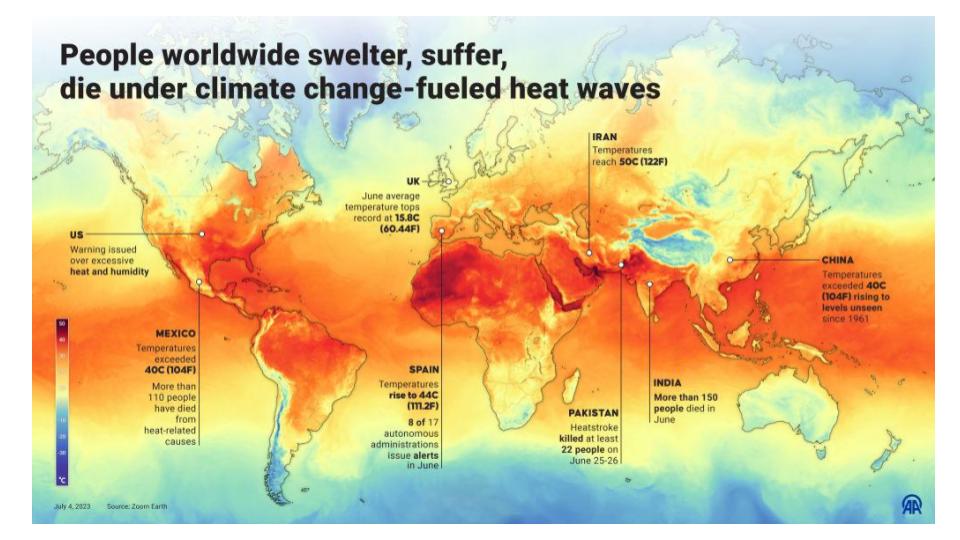
Last month was the hottest June on record, the EU’s climate change monitoring service said on Monday, continuing a streak of exceptional temperatures that some scientists said puts 2024 on track to be the world’s hottest recorded year.
Every month since June 2023 – 13 months in a row – has ranked as the planet’s hottest since records began, compared with the corresponding month in previous years, the European Union’s Copernicus Climate Change Service (C3S) said in a monthly bulletin.
The latest data suggest 2024 could outrank 2023 as the hottest year since records began after human-caused climate change and the El Nino natural weather phenomenon both pushed temperatures to record highs in the year so far, some scientists said.
“I now estimate that there is an approximately 95% chance that 2024 beats 2023 to be the warmest year since global surface temperature records began in the mid-1800s,” said Zeke Hausfather, a research scientist at Berkeley Earth.
The changed climate has already unleashed disastrous consequences around the world in 2024.
More than 1,000 people died in fierce heat during the haj pilgrimage last month. Heat deaths were recorded in New Dehli, which endured an unprecedentedly long heatwave, and amongst Greek tourists.
Friederike Otto, a climate scientist at Imperial College London’s Grantham Institute, said there was a “high chance” 2024 would rank as the hottest year on record.
“El Nino is a naturally occurring phenomenon that will always come and go. We can’t stop El Nino, but we can stop burning oil, gas, and coal,” she said.
The natural El Nino phenomenon, which warms the surface waters in the eastern Pacific Ocean, tends to raise global average temperatures.
That effect subsided in recent months, with the world now in neutral conditions before cooler La Nina conditions are expected to form later this year.
Greenhouse gas emissions from burning fossil fuels are the main cause of climate change.
Despite promises to curb global warming, countries have so far failed collectively to reduce these emissions, pushing temperatures steadily higher for decades.
In the 12 months ending in June, the world’s average temperature was the highest on record for any such period, at 1.64 degrees Celsius above the average in the 1850-1900 pre-industrial period, C3S said.
(Reuters)