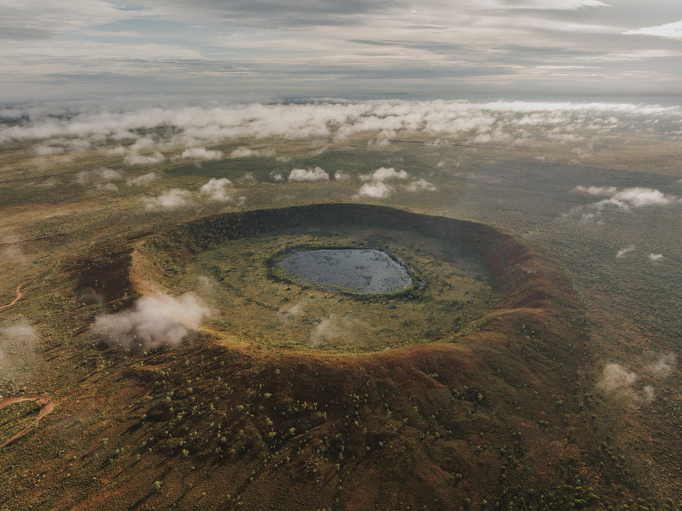
The space rock that slammed into Earth 66 million years ago at the end of the Cretaceous Period caused a global calamity that doomed the dinosaurs and many other life forms. But that was far from the largest meteorite to strike our planet.
One up to 200 times bigger landed 3.26 billion years ago, triggering worldwide destruction at an even greater scale. But, as new research shows, that disaster actually may have been beneficial for the early evolution of life by serving as “a giant fertilizer bomb” for the bacteria and other single-celled organisms called archaea that held dominion at the time, providing access to the key nutrients phosphorous and iron.
Researchers assessed the effects of this meteorite impact using evidence from ancient rocks in a region in northeastern South Africa called the Barberton Greenstone Belt. They found ample signs – mostly from the geochemical signature of preserved organic material but also from fossils of mats of marine bacteria – that life bounced back with aplomb.
“Life not only recovered quickly once conditions returned to normal within a few years to decades, it actually thrived,” said Harvard University geologist Nadja Drabon, lead author of the study published on Monday in the journal Proceedings of the National Academy of Sciences.
Earth was a much different place during the Paleoarchean Era when this occurred, and meteorite impacts were larger and more frequent.
“At this time, Earth was something of a water world, with limited emergence of volcanoes and continental rocks. There was essentially no oxygen gas in the atmosphere and oceans, and no cells with nuclei,” Harvard geologist and study co-author Andrew Knoll said.
The meteorite was a type called a carbonaceous chondrite that is rich in carbon and also contains phosphorus. Its diameter was approximately 23-36 miles (37-58 km), Drabon said, making it about 50-200 times the mass of the asteroid that wiped out the dinosaurs, aside from their bird descendants.
“The effects of the impact would have been quick and ferocious. The impactor hit with so much energy that it and whatever sediment or rock it hit vaporized. This rock vapor cloud and dust ejected from the crater would have circled the globe and turned the sky black within hours,” Drabon said.
“The impact likely occurred in the ocean, initiating a tsunami that swept across the globe, ripping up the sea floor and inundating coastlines. Lastly, a lot of the impact energy would get transferred into heat, meaning that the atmosphere started heating up so much that the upper layer of the oceans started boiling,” Drabon added.
It probably would have taken a few years to decades for the dust to settle and for the atmosphere to cool enough for the water vapor to return to the ocean, Drabon said. Microbes depending on sunlight and those in shallow waters would have been decimated.
But the meteorite would have delivered a large amount of phosphorous, a nutrient for microbes crucial for the molecules central to storing and conveying genetic information. The tsunami also would have mixed iron-rich deep waters into shallower waters, creating an environment ideal for many types of microbes because iron provides them with an energy source.
“Imagine these impacts to be giant fertilizer bombs,” Drabon said.
“We think of meteorite impacts as being disastrous and detrimental to life – the best example being the Chicxulub impact (at Mexico’s Yucatan Peninsula) that led to the extinction of not only the dinosaurs but also of 60-80% of animal species on Earth,” Drabon said. “But 3.2 billion years ago, life was a lot simpler.”
“Microorganisms are relatively simple, versatile, and they reproduce at fast rates,” Drabon said.
The evidence of the impact included chemical signatures of the meteorite, small spherical structures formed from rock melted by the impact, and chunks of seabed mixed with other debris churned up by the tsunami in sedimentary rock.
“Early life was resilient in the face of a giant impact,” Drabon said.
(Reuters)