












The Bankers’ Books Evidence Act, 2026 will come into force from October 1, replacing the Bankers’ Books Evidence Act, 1891 and introducing a modern, technology-neutral framework for the use of banking records as evidence in legal proceedings.
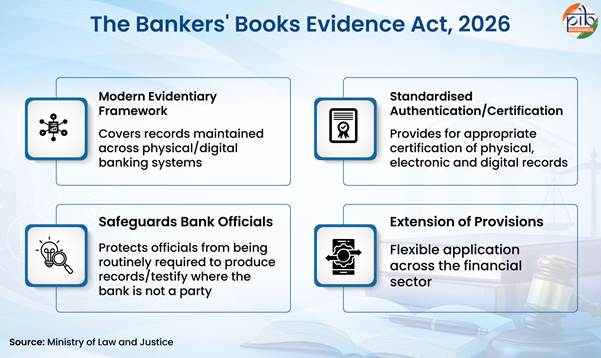
The new law provides updated rules for the admissibility, authentication and certification of banking records, covering physical, electronic and digital records maintained in the ordinary course of banking business.
The Act will apply to legal proceedings, arbitrations, investigations and inquiries where banking records are required to be produced as evidence.
Under the new legislation, “bankers’ books” include ledgers, day-books, cash-books, account books and other records maintained in the ordinary course of a bank’s business. Such records may be maintained in written or physical form or stored through data storage mechanisms.
A key change under the Act is the recognition of electronic and digital records of bankers’ books as admissible, valid and legally enforceable evidence, subject to prescribed conditions.
For an electronic or digital record to be admissible, the certified copy must correctly represent or be appropriately derived from the original record. The law also requires that there be no unauthorised changes to the data and no detected tampering or other event affecting the integrity and accuracy of the system.
The Act also standardises the certification process and permits authentication through manual, digital and electronic signatures.
The legislation retains the existing framework under which banking records can be proved through certified copies, without requiring the original banker’s book to be produced before a court.
It also provides safeguards for bank officials. A bank officer cannot ordinarily be compelled to produce a banker’s book or appear as a witness merely to prove banking records, particularly when the bank is not a party to the proceedings.
However, a court may require a bank officer to appear as a witness or produce a banker’s book through a written order recording a special cause.
The Act specifies circumstances that may constitute such a special cause, including uncertainty over the accuracy or authenticity of an entry or information, interruption in the regular or ordinary record-keeping process, or failure by the bank to comply with a previous court order concerning inspection or production of certified copies.
The new law also provides for its extension to other entities operating in the financial sector. The government may, through notification, extend the provisions of the Act to specified financial-sector entities, with conditions, exceptions or modifications as prescribed.
The legislation replaces a law enacted in 1891, when banking systems were predominantly paper-based. The new framework seeks to align evidentiary rules with the increasing use of digital platforms for banking and financial transactions.
The Bankers’ Books Evidence Act, 2026 is aimed at providing greater clarity and procedural safeguards in the production and verification of banking records while accommodating developments in electronic and digital banking.







