








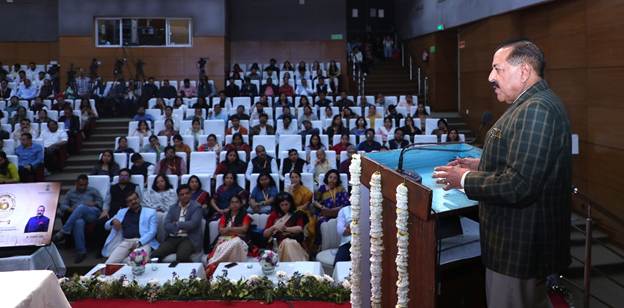
Union Minister of State (Independent Charge) for Science and Technology Jitendra Singh on Tuesday said biotechnology will drive the next industrial revolution, as India steadily moves towards building a USD 1 trillion bioeconomy by 2047.
Addressing the 40th Foundation Day celebrations of the Department of Biotechnology (DBT) in New Delhi, the Minister launched “SUJVIKA”, an AI-driven biotech product data portal developed in collaboration with industry body ABLE.
Singh said India has ensured that it does not remain a late entrant in emerging technologies and has positioned biotechnology as a key pillar of future economic growth under the vision of Viksit Bharat.
The SUJVIKA portal is a trade statistics digital intelligence platform that presents authenticated biotechnology product import data in a structured format. It provides sector-wise insights into biochemical products, industrial enzymes and other biotech imports, enabling researchers, startups and industry to identify high-value imports, assess import dependence and prioritise indigenisation and R&D efforts. The portal is also aimed at supporting evidence-based planning and strengthening public–private partnerships in biomanufacturing.
Congratulating the DBT fraternity on completing 40 years since its establishment in 1986, the Minister said the Department has evolved into a premier institution nurturing startups, strengthening academia–industry linkages and enabling innovation for societal benefit.
Singh said the number of biotech startups in India has risen sharply from fewer than 100 in 2014 to over 11,000 today. During the same period, India’s bioeconomy expanded nearly 16-fold, growing from about USD 10 billion in 2014 to USD 165.7 billion in 2024, placing the country among the leading global biotech destinations and vaccine manufacturing hubs.
Referring to policy reforms, the Minister said the Union Cabinet approved the integrated BioE3 Policy — Biotechnology for Economy, Environment and Employment — to promote high-performance biomanufacturing across the country. He said DBT, BIRAC and the Biotechnology Research and Innovation Council (BRIC) are implementing the policy to strengthen indigenous capabilities and expand India’s bioindustrial base.
Singh also highlighted the establishment of a National Biofoundry Network comprising six specialised biofoundries and 21 advanced bio-enabler facilities, along with a network of 95 bio-incubators across 21 States and Union Territories. He said these facilities are supporting over 1,800 incubatees nationwide.
The Minister said the recently announced first national call of ₹2,000 crore under the ₹1 lakh crore Research, Development and Innovation initiative will further boost biotech enterprises that are ready for large-scale growth.
Highlighting emerging frontiers, Singh said India has entered new areas such as space biotechnology and space medicine through collaboration between DBT and ISRO, with life science experiments conducted during space missions.
He also referred to the GenomeIndia Project, under which whole genome sequencing data of 10,000 individuals from 99 diverse populations has been made available, enabling advances in personalised medicine and genomic research. The Minister further highlighted India’s first human gene therapy trial for Severe Hemophilia A, supported by DBT and BIRAC, which showed sustained clinical benefits.
Singh said the integration of biotechnology with artificial intelligence will accelerate research, reduce timelines and improve precision in diagnostics, gene sequencing and drug discovery. He emphasised greater coordination among scientific departments to fully realise biotechnology’s potential.
On the occasion, the Minister also launched DBT’s revamped website aligned with the Government of India’s Digital Brand Identity framework.
Earlier, DBT Secretary Dr Rajesh S. Gokhale said the Department has played a key role in building scientific capacity, fostering entrepreneurship and translating research into societal impact over the past four decades.