







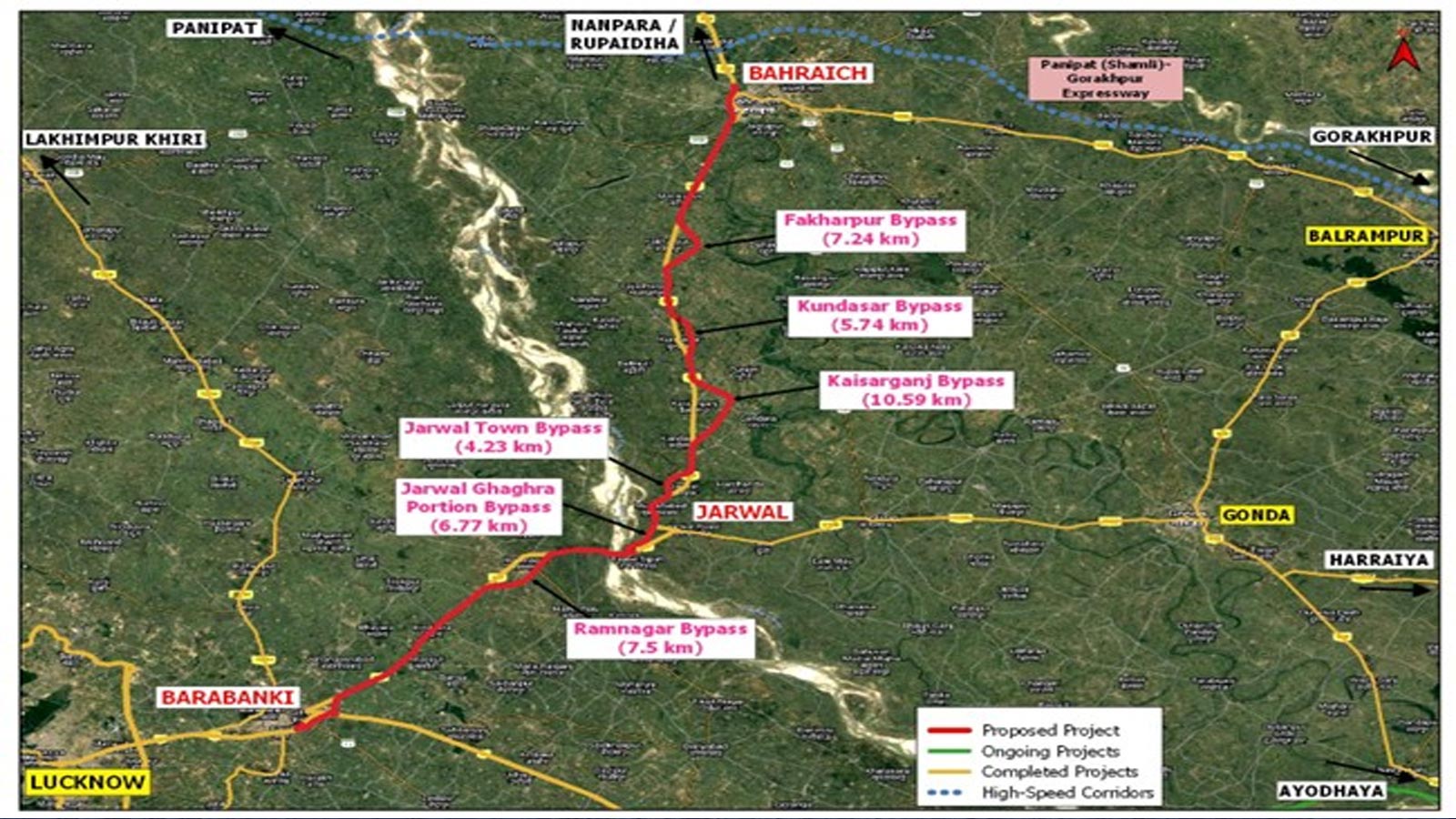
The Cabinet Committee on Economic Affairs (CCEA), chaired by Prime Minister Narendra Modi, has approved the construction of a 4-lane access-controlled National Highway-927 from Barabanki to Bahraich in Uttar Pradesh at a cost of ₹6,969.04 crore.
The 101.5-km project, to be developed under the Hybrid Annuity Mode (HAM), is part of the Lucknow-Rupaidiha corridor and aims to significantly enhance regional connectivity and economic activity.
Improved connectivity and safety
The project will address existing issues such as sharp curves, geometric deficiencies and congestion in densely populated stretches of Barabanki and Bahraich districts.
Designed with access control and continuous service roads, the highway will bypass major habitations, increase average travel speeds, reduce travel time to around one hour, and improve road safety and fuel efficiency.
Boost to trade and cross-border connectivity
The upgraded corridor will provide seamless connectivity to key infrastructure and economic hubs, linking – National Highways including NH-27, NH-330B and NH-730; and state highways such as SH-13 and SH-30B.
The project is expected to enhance multi-modal integration, connecting airports, railway stations and logistics hubs, including the strategically important Rupaidiha Land Port near the India-Nepal border.
Once completed, the highway will serve as a key trade and transit route between India and Nepal, improving access to the Nepalganj border and facilitating faster movement of goods and passengers.
Economic growth and employment
The project is expected to generate substantial employment, with an estimated – 36.54 lakh person-days (direct); and 43.04 lakh person-days (indirect).
It will also support agriculture, tourism, logistics and cross-border commerce, particularly in districts such as Bahraich and Shravasti.
Key towns and nodes connected
The highway will connect several important towns, including Barabanki, Ramnagar, Jarwal, Kaisarganj and Bahraich, while linking to key economic and social nodes such as Special Economic Zones, Mega Food Parks and aspirational districts.
With an estimated traffic volume of over 28,000 passenger car units (PCUs) by FY 2027-28, the project is expected to play a crucial role in strengthening regional mobility.
The approval aligns with the government’s PM GatiShakti initiative, aimed at developing integrated and efficient infrastructure networks across the country.