











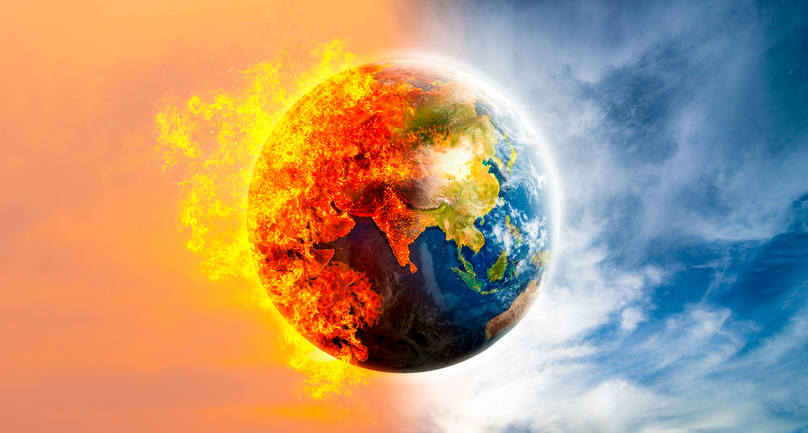
Even greater efforts to strip carbon dioxide from the atmosphere will fail to avert climate change catastrophe as rising global temperatures threaten to cross a key threshold of 1.5 degrees Celsius (2.7 degrees Fahrenheit), scientists said last week.
The Intergovernmental Panel on Climate Change (IPCC) has said carbon dioxide removal (CDR) could help slow warming by reducing greenhouse gas already accumulated in the atmosphere, and even temperatures, especially if 1.5 C is exceeded.
However, even if removing carbon dioxide works, it can do nothing to mitigate other aspects of climate change, from sea level rises to changes in ocean circulation, scientists said in research published in the journal Nature on Wednesday.
“Even if you’ve brought temperatures back down again, the world we will be looking at will not be the same,” said Carl-Friedrich Schleussner of Austria’s International Institute of Applied Systems Analysis, one of the paper’s authors.
The research showed cutting temperatures from their peak could also prove harder than anticipated even if CDR is scaled up, particularly as melting permafrost and shrinking peatlands release methane and drive further warming.
CDR refers to a range of techniques that extract and store away CO2 already in the atmosphere, including natural solutions such as forests and ocean algae, as well as new technologies that filter carbon dioxide from the air.
Existing CDR capacity takes about 2 billion metric tons of CO2 out of the atmosphere every year, but that figure must rise to about 7 billion to 9 billion tons to meet the world’s climate goals, a separate research report said in June.
Yet there are limits to how much new forest can be planted and how much CO2 can be permanently sequestered, while current technologies are expensive, said Joeri Rogelj of Imperial College London, another co-author of the paper in Nature.
“If we are starting to use land exclusively for carbon management, this can strongly conflict with the other important roles of land, be it biodiversity (or) food production,” he told a briefing.
Even the most optimistic emissions reduction scenario in the IPCC’s latest assessment report, published last year, factored in the possibility of a small overshoot of 0.1 C.
Reversing that would require the removal of about 220 billion tons of CO2, while an overshoot of 0.5 C – also consistent with the IPCC’s best-case scenario – would need more than a trillion tons removed, Rogelj said.
“The risks the world exposes itself to (from) an overshoot are much larger than acknowledged,” he said.
“Only through ambitious emissions reductions in the near term can we effectively reduce the risks from climate change.”
(Reuters)


