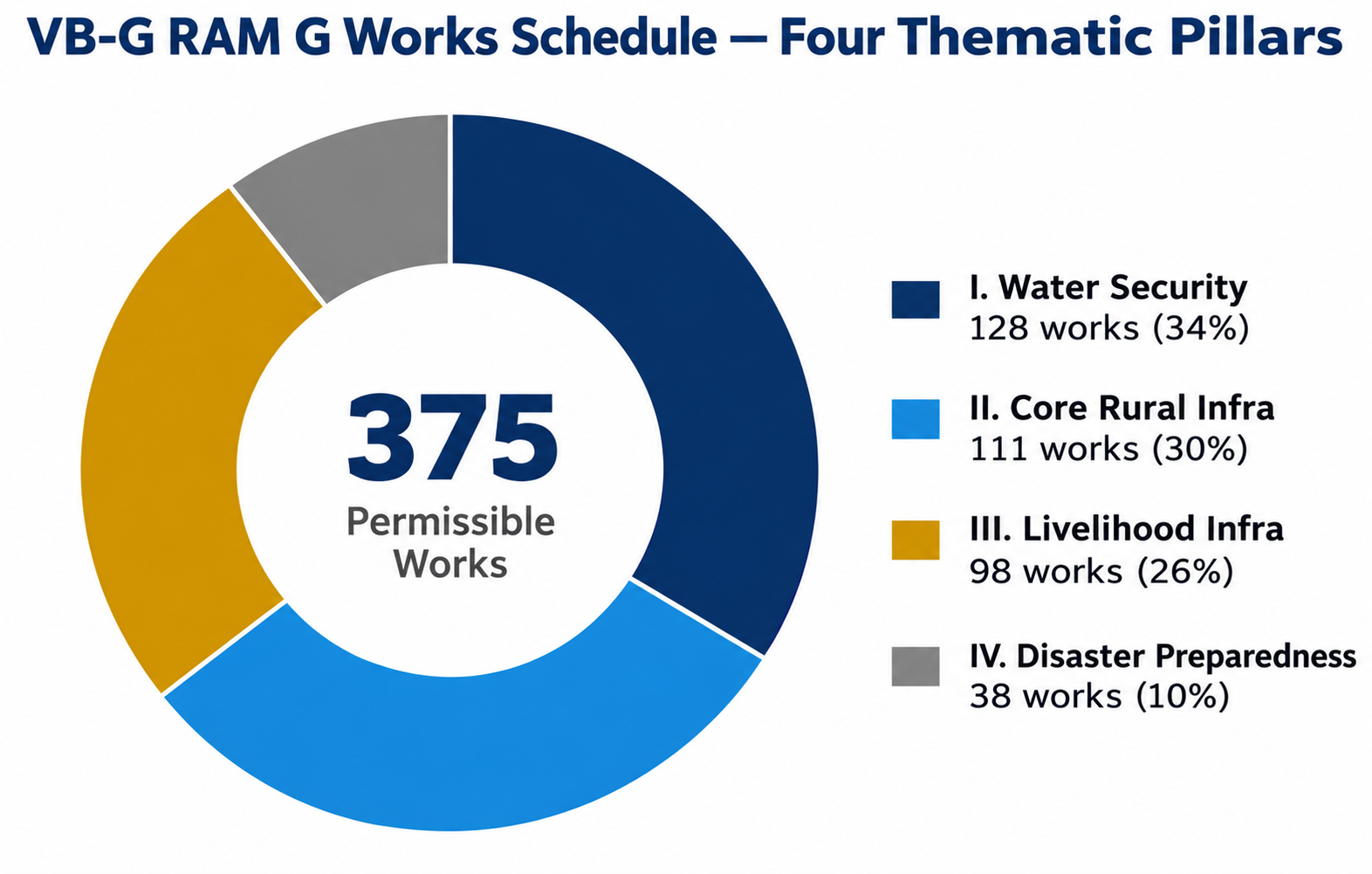
The Ministry of Rural Development has notified 375 permissible works under the Viksit Bharat–Guarantee for Rozgar and Ajeevika Mission (Gramin), or VB–G RAM G Act, 2025, expanding the scope of the rural works framework by 41 per cent compared with the previous scheme.
The new Schedule of Permissible Works replaces the earlier list of 266 works and reorganises rural works into four broad areas — Water Security, Core Rural Infrastructure, Livelihood-related Infrastructure, and Special Works for Extreme Weather Events and Disaster Preparedness.
The Ministry said the new framework aims to link wage employment with the creation of durable rural assets and measurable development outcomes.
Under the new system, works will be identified through a bottom-up planning process under the Viksit Gram Panchayat Plan and approved by the Gram Sabha. The works will also be digitally tracked through the Viksit Bharat National Rural Infrastructure Stack.
Water Security accounts for the largest share, with 128 permissible works. These include check dams, gully plugs, underground dykes, recharge shafts, injection wells and the rejuvenation of rivers, rivulets and nallahs.
The list also includes drip irrigation, sprinkler systems, rooftop rainwater harvesting and tankas, besides newer interventions such as ice stupas and artificial glaciers for water conservation and irrigation.
The second-largest category is Core Rural Infrastructure, with 111 works aimed at strengthening essential infrastructure and community facilities in rural areas.
These include solar street lighting, waste-to-wealth recycling plants, greywater treatment units, rural libraries, veterinary and rural health centres, Common Service Centres, multipurpose youth centres, additional classrooms and laboratories in government schools, as well as repair and maintenance of Jal Jeevan Mission water-supply infrastructure.
The framework also places greater emphasis on livelihood-related infrastructure, with 98 permissible works. These cover agro-processing and value-addition facilities, cleaning, grading and packaging units, cold storage, mini flour mills, market yards, dairy infrastructure, mushroom cultivation sheds, sericulture sheds, poly-houses and aquaculture structures.
Infrastructure for Self-Help Groups and their federations, including SHG worksheds, SHE Marts and federation buildings, has also been included. Training-cum-skill development centres are among the other permissible works.
According to the Ministry, livelihood-related works will account for 26 per cent of the total permissible works, compared with 1.1 per cent under the previous framework.
For the first time, a separate category focusing on Disaster Preparedness and Extreme Weather Events has been included, comprising 38 works.
These include flood relief shelters, retaining walls, embankment strengthening, flood protection works and post-disaster restoration of rural roads and community assets. Forest-fire management measures, including fire lines and fuel-buffer zones, have also been included.
The category is aimed at improving the resilience of rural communities and assets against floods, cyclones, storms, droughts, landslides and forest fires.
The Schedule also gives specific attention to farmers, vulnerable households, women and rural youth. A total of 181 works relate to agriculture and allied activities, including 52 individual-beneficiary works covering water, land, plantations, livestock and other productive assets.
Another 107 works have been tagged for Antyodaya and vulnerable households, including 68 individual-beneficiary works covering housing, sanitation, energy, irrigation, plantations and livestock shelters.
The framework includes 36 works related to Nari Shakti and 36 related to Yuva Shakti, covering infrastructure for women’s collectives, Self-Help Groups and federations, youth centres, skill development and enterprise-linked infrastructure.
The new Schedule also includes provisions for Divyangjan accessibility, renewable-energy infrastructure and circular-economy interventions such as waste-to-wealth recycling and greywater treatment.
The Ministry said the Viksit Gram Panchayat Plans will enable works to be selected according to local needs and approved by Gram Sabhas. Digital tracking through the Viksit Bharat National Rural Infrastructure Stack is expected to facilitate convergence among Central, State and local schemes while helping prevent duplication.
-PIB