








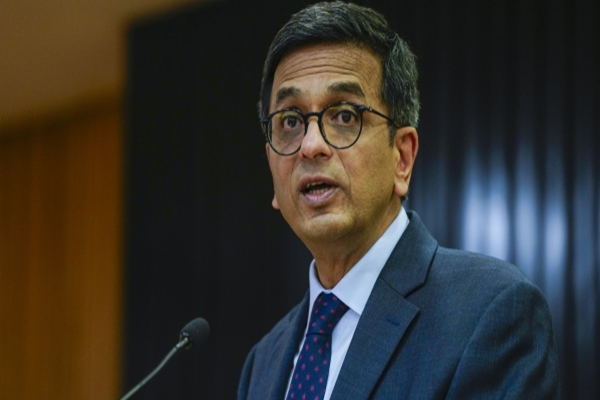
Chief Justice of India DY Chandrachud said on Sunday that the time has come to think of national integration by recruiting members to the judicial services across the narrow walls of regionalism and state-centered selections.
In his valedictory address at the National Conference of the District Judiciary to mark 75 years of the Supreme Court of India, Chief Justice of India Chandrachud said that at the district level vacancies in judicial personnel stand at 28 per cent and of non-judicial staff at 27 per cent.
“In order for the disposals to outweigh the institution of cases the courts must work beyond the capacity of 71 per cent to 100 per cent. To fill the vacancies, the conference deliberated upon the criteria for selection of judges and standardizing the recruitment calendars for all vacancies,” CJI said.
He said that developments in judicial infrastructure have a direct impact on the ability to reduce pendency. “Our current national average disposal rate stands at 95 per cent. Despite progress, tackling pending cases remains a challenge. Increasing our disposal-to-filing ratio hinges on attracting skilled personnel,” CJI said.
He further said that the Centre for Research and Planning of the Supreme Court of India has been preparing a white paper to integrate the state-level training modules at the State Judicial Academy with national and international best practices.
“Currently, some of the courses at the State Judicial Academies have a robust curriculum while the others focus on re-engaging a newly qualified judge with law subjects. We are in the process of setting up a systematic, nationwide curriculum for judicial training and harness technology to track our progress. The new curriculum promises to bring innovative training methods, a thematic framework, uniformity in training calendars, integrating judicial training with IT, recasting the National Judicial Academy to fill knowledge gaps and most importantly to establish a feedback and assessment methodology,” the CJI said.
“I have always believed that our practices and initiatives must be institutionalized. It is often difficult to ensure that our practices are not just a one off endeavor but becomes native to the institution. When it comes to judicuial training, we have periodically seen the curriculum being updated. However, now it is time to truly harness our best practices and ensure that every last judicial officer is a beneficiary of the best which we have to offer through innovative pedagogical approaches,” he added.
“Finally, the perceived gap between the district judiciary and the High Courts must be bridged. This gap is a product of colonial subordination,” he further said. (ANI)