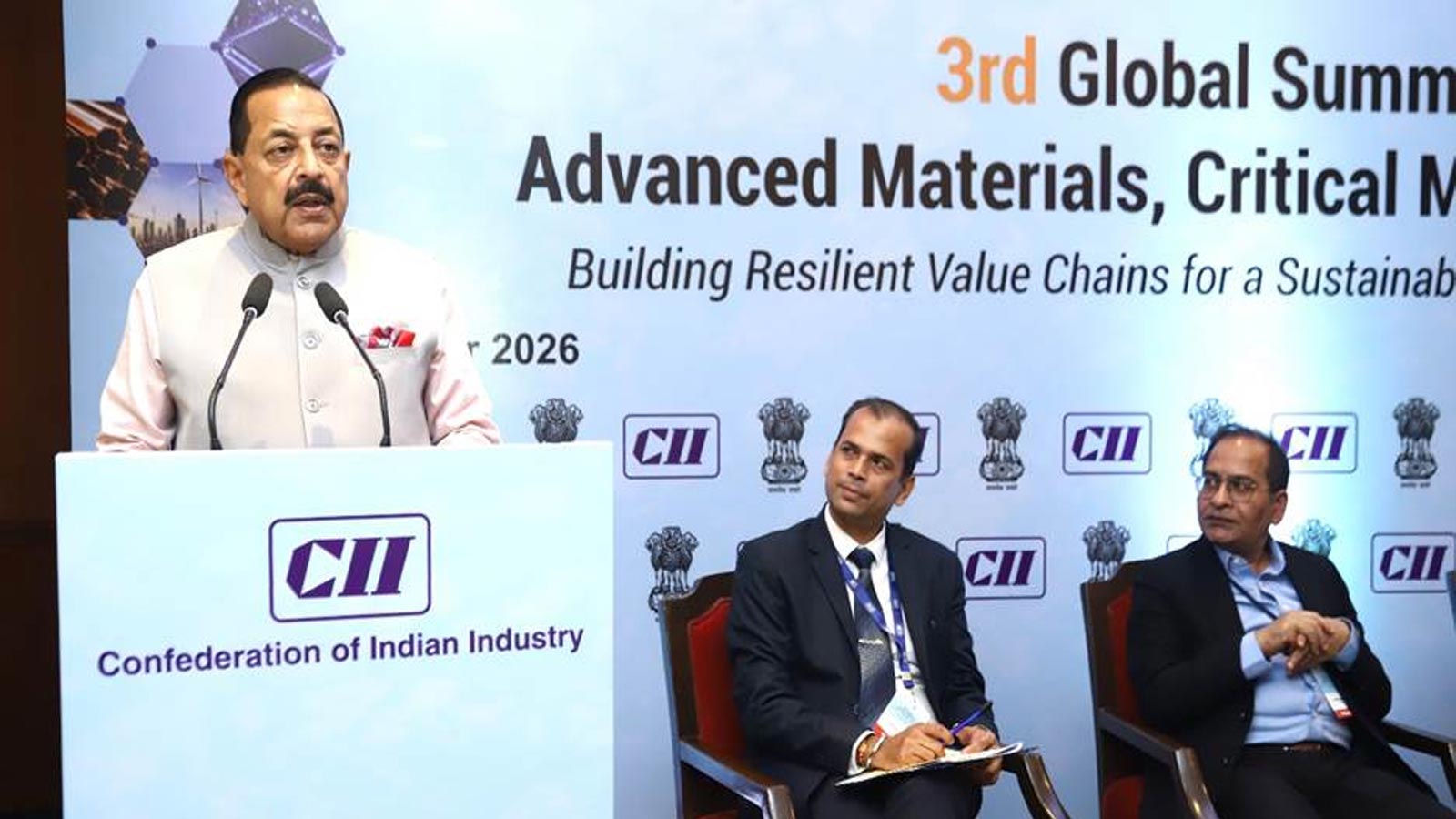
Union Minister of State for Science and Technology Jitendra Singh on Friday described critical minerals and advanced materials as strategic assets essential to India’s energy security, industrial competitiveness and national security, calling for stronger domestic capabilities and deeper partnerships between government, industry and research institutions.
Addressing the Special Plenary of the 3rd Global Summit on Advanced Materials, Critical Minerals & Metals in New Delhi, Singh said India is moving from being a technology follower to a confident global player and must prepare to play a larger role in emerging technologies.
The summit, organised by the Confederation of Indian Industry (CII) at India Habitat Centre, was held on the theme “Building Resilient Value Chains for a Sustainable and Competitive Future.”
Build capabilities across the entire value chain
Singh said the global economy is undergoing a major technological transformation, with clean energy, electric mobility, semiconductors, telecommunications, aerospace, defence and nuclear energy emerging as key drivers.
Against this backdrop, India needs capabilities across the entire critical-minerals value chain, from exploration and extraction to refining, processing, engineering and manufacturing, he said.
The Minister stressed that domestic resources must be optimally combined with international resources and partnerships, while India simultaneously develops indigenous technologies and globally competitive standards.
He called for a whole-of-government and whole-of-nation approach, with industry playing an integral role in building resilient supply chains for strategic materials and technologies.
Private sector participation in strategic sectors
Singh highlighted the government’s efforts to expand private-sector participation in areas traditionally considered beyond the reach of private industry. He particularly cited the opening up of the nuclear sector to private players as an important shift in India’s approach to strategic technology and investment.
He invited international investors and industries, including those from Canada and other countries, to participate in opportunities emerging from India’s opening of the nuclear sector, noting that the new framework provides scope for foreign collaboration and investment alongside greater domestic participation.
Referring to the RDI Fund, Singh said the initiative announced by the Prime Minister has moved into the implementation stage and could help increase private-sector participation in strategic areas where industry has traditionally been reluctant to invest.
Early industry linkages crucial for commercialisation
The Minister called for industry to be involved at an early stage of research and innovation so that projects remain aligned with market requirements and have better prospects of becoming commercially viable.
He stressed the importance of stronger synergy among research institutions, industry, government, startups, entrepreneurs and the non-government sector to sustain innovation and accelerate commercialisation.
Singh also called for greater investment in research and innovation and urged industry and leading business houses to develop a stronger culture of philanthropy for research, describing support for knowledge creation as a contribution to the larger welfare of humanity.
From waste to resource through innovation
Citing India’s experience of using steel slag for road construction, Singh said collaboration between government and industry can transform materials previously regarded as waste into productive resources.
The example, he said, demonstrated that there is virtually no waste when materials are approached through innovation and appropriate technology.
Five priorities for strategic technology ecosystem
Singh outlined five broad priorities for India’s strategic technology and advanced materials ecosystem: greater investment in research and innovation; development of domestic capabilities for energy security; deeper partnerships among stakeholders; global collaboration and recycling models; and a stronger culture of philanthropy for research.
He emphasised that strengthening domestic capabilities is particularly important as the global energy system shifts towards cleaner and greener sources. Reducing vulnerabilities arising from external dependence, he said, will be essential for India’s long-term energy security and industrial competitiveness.
Singh said India is at a significant stage in its technological journey, with opportunities emerging across advanced materials, critical minerals, nuclear energy, space and other strategic sectors.
He expressed confidence in India’s growing ability to assume a larger global role, stressing that the next phase of growth would depend on government, industry, researchers, startups, investors and international partners working together as equal stakeholders.