The Ministry of Agriculture & Farmers Welfare has implemented key initiatives to boost farmers’ income, with the Government’s Minimum Support Price (MSP) policy ensuring fair prices for major agricultural commodities.
This encourages higher investments in farming, boosting both production and productivity.
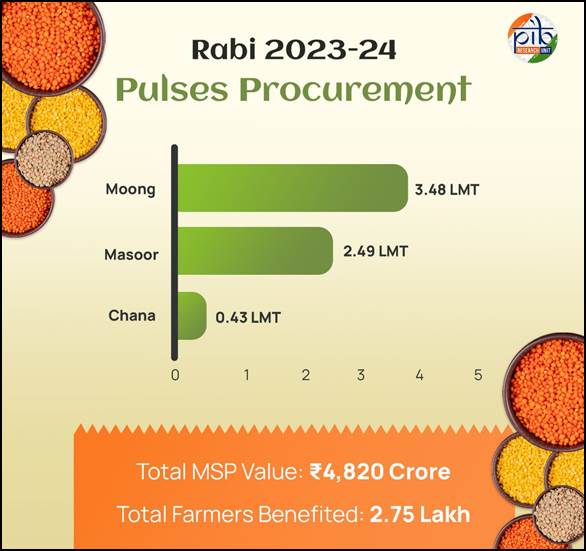
In the Rabi season of 2023-24, the government procured 6.41 LMT of pulses, benefiting 2.75 lakh farmers.
This procurement, part of the Pradhan Mantri Annadata Aay Sanrakshan Abhiyan (PM-AASHA), provides crucial price support for pulses, oilseeds, and copra, offering financial stability and protecting small and marginal farmers from market volatility.
Launched in 2018, PM-AASHA safeguards farmers through MSP and addresses post-harvest distress with schemes like the Price Support Scheme (PSS), Price Deficiency Payment Scheme (PDPS), and Market Intervention Scheme (MIS).
These measures promote crop diversification, fair pricing, and reduce the burden on farmers facing unfavourable market conditions.
In 2024, the government further pushed for Atmanirbharta (self-reliance) in pulses by lifting procurement ceilings for key crops like Tur, Urad, and Masoor.
Under PSS, 5.62 LMT of soybeans were procured during the Kharif season, benefiting over 2.42 lakh farmers. Rabi oilseeds procurement reached 12.19 LMT, helping 5.29 lakh farmers.
Since its inception, PM-AASHA has benefited 99.30 lakh farmers through the procurement of 195.39 LMT of pulses, oilseeds, and copra at an MSP value of Rs. 1,07,433.73 crore.
Through PDPS and MIS, PM-AASHA extends support to price-sensitive crops like tomatoes, onions, and potatoes, ensuring fair compensation when market prices drop.
These schemes bridge the price gap between production and consumption markets, protecting farmers from volatile market conditions.
PM-AASHA demonstrates the government’s commitment to empowering farmers, ensuring stable incomes, and promoting inclusive rural growth.
By stabilizing market prices and reducing dependence on intermediaries, the scheme offers small and marginal farmers a reliable safety net, helping them navigate market uncertainties and secure their livelihoods.