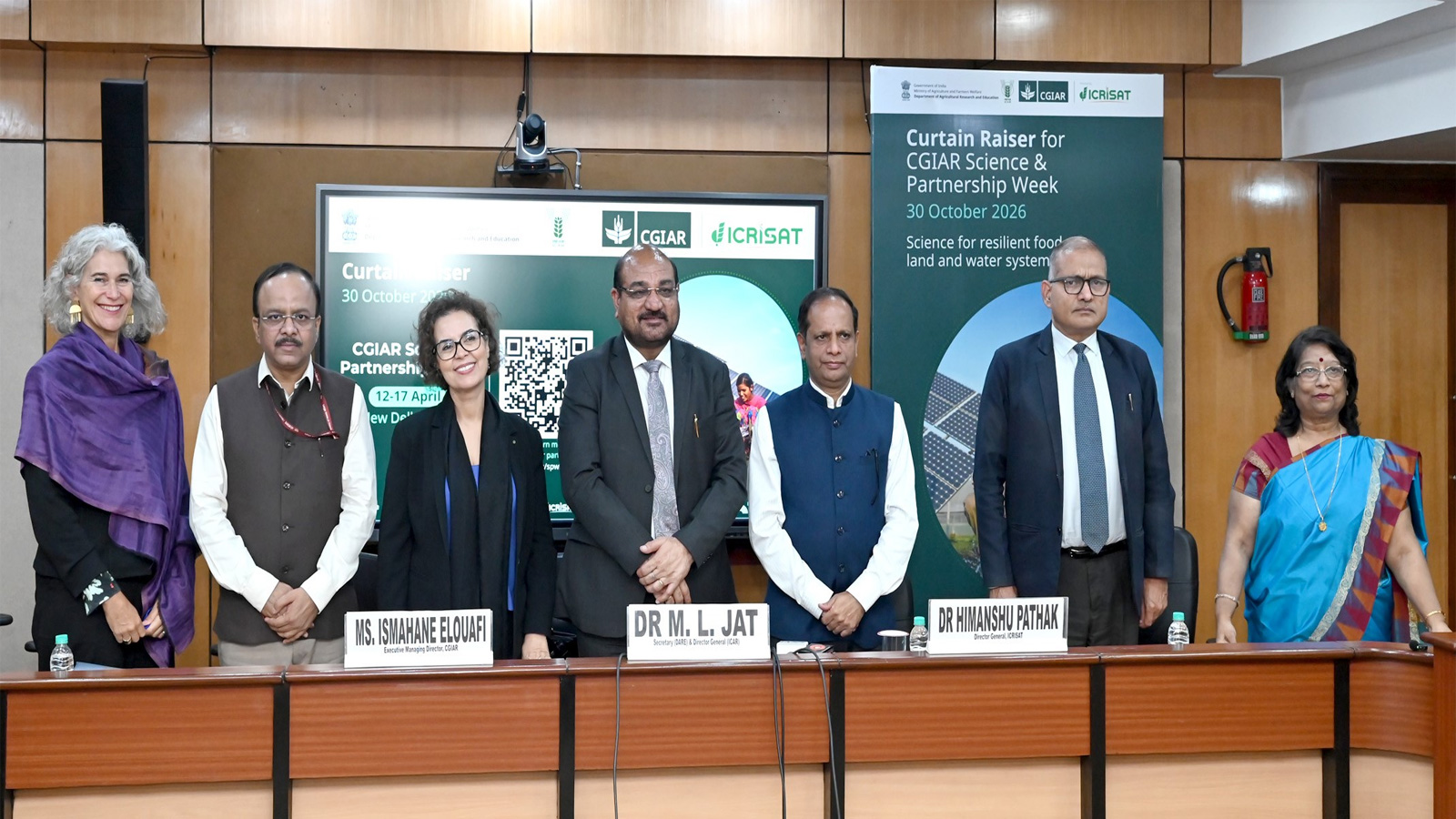
India will host the ICAR–CGIAR Science and Partnership Week from April 12 to 17, 2027, bringing together more than 5,000 delegates to discuss agricultural innovations, strengthen research partnerships and expand cooperation with the Global South.
The event, announced on Friday by the Indian Council of Agricultural Research (ICAR) and CGIAR, will bring researchers, farmers, governments, startups and businesses to New Delhi. It will examine innovations already reaching farmers and the work needed to extend their benefits.
Organised by ICAR under the Department of Agricultural Research and Education (DARE), Ministry of Agriculture and Farmers Welfare, and CGIAR, the week will focus on translating scientific research into practical outcomes and advancing South-South cooperation.
Dr M. L. Jat, Secretary, DARE, and Director General, ICAR, said India’s partnership with CGIAR had supported agricultural research and development for more than five decades, contributing to crop improvement, natural resource management, food security and productivity.
He highlighted the role of international research institutions, including CIMMYT, IRRI and ICRISAT, in India’s transition from a food-deficit country dependent on imports to a major food producer and exporter.
India would prioritise sharing successful agricultural innovations with the Global South, particularly African countries, he said. Climate-resilient farming, digital agriculture and AgriStack, mechanisation, millets, natural farming and sustainable agricultural practices offered opportunities for collaboration.
Dr Jat said discussions would cover priorities across the agri-food value chain, including water management, soil health, public-private partnerships, startups, participation by young people and women, and the media’s role in communicating agricultural science.
CGIAR is an international agricultural research partnership comprising 15 research centres working across more than 100 countries. Ten of its centres operate in India, covering crops, water, livestock, fisheries, nutrition and policy.
Dr Ismahane Elouafi, Executive Managing Director of CGIAR, said the event would celebrate the partnership’s achievements while helping shape an agenda for the next 50 years of cooperation.
She said India had demonstrated what strong national scientific capabilities could achieve at scale, with Indian seeds and knowledge already supporting farmers in Africa and Asia. The New Delhi meeting would build on those exchanges and examine where science could make a greater contribution.
Dr Himanshu Pathak, Director General of ICRISAT, said India’s agricultural transformation reflected the combined contribution of science, technology and international partnerships.
“Through CGIAR Science and Partnership Week 2027, we aim to showcase India’s agricultural achievements, share our innovations with the world and learn from global advancements to co-create solutions for the emerging challenges of agriculture and food systems,” he said.
The announcement also highlighted examples of India’s contribution to agriculture beyond its borders. A groundnut sample from India, conserved and shared by ICRISAT, contributed to varieties now grown in Malawi, Uganda, Mozambique and Zambia. Hyderabad’s Centre of Excellence for South-South Cooperation in Agriculture also shares proven farming innovations across Asia, Africa and Latin America.
The first CGIAR Science Week was held in Nairobi, Kenya, in April 2025, when the organisation launched its current research portfolio. The New Delhi edition will also explore how agricultural research and innovation can support India’s vision for 2047.
The programme and speakers will be announced in the coming months.
(PIB)