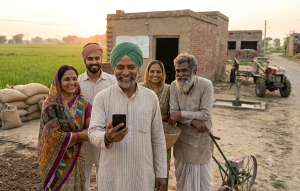
In a country where the slogan “Jai Jawan, Jai Kisan” echoes through political speeches and patriotic songs, a grim reality persists in the fields—farmers continue to take their own lives in staggering numbers.
A recent Right to Information (RTI) query filed by Pune-based businessman Praful Sarda has exposed the scale of India’s agrarian distress, revealing that 2.58 lakh farmers died by suicide between 2004 and 2022.
The data draws a stark contrast between two political regimes. During the United Progressive Alliance (UPA) rule (2004–2014), India recorded 1,70,505 farmer suicides. In comparison, the National Democratic Alliance (NDA) period (2015–2022) saw 88,117 such deaths—a reduction of nearly 50 per cent. While the decline is statistically notable, the numbers remain deeply troubling.
Maharashtra emerges as the epicentre, accounting for 40,852 suicides during the UPA years and 31,492 under the NDA. Karnataka, Andhra Pradesh, and Madhya Pradesh follow, each recording tens of thousands of cases.
Notably, Bihar and West Bengal reported zero farmer suicides during the NDA period—a detail that raises questions about regional disparities in both agricultural policy and reporting standards, Sarda pointed out while speaking to IANS.
Sarda, who accessed the figures through his RTI application, was blunt in his assessment. “The death of 2.58 lakh farmers exposes the failure of our system. Farmers are still troubled by debt, cost, market, and weather. Governments kept changing, speeches kept changing, but the fate of farmers did not change.”
The causes behind these suicides are tragically familiar—crushing debt, inadequate minimum support prices (MSP), erratic weather, crop failures, and limited access to technology. Despite a slew of central schemes—from PM-KISAN to crop insurance and soil health cards—many farmers remain outside the safety net. The benefits, Sarda argues, are reaching only a fraction of those in need.
Experts warn that India may be inching towards an “agricultural emergency.” The numbers suggest not just a policy gap, but a systemic failure in how the country supports its food producers.
While the NDA government has succeeded in reducing the suicide rate, the persistence of the crisis in key states underscores the need for deeper reforms. Sarda said Maharashtra, in particular, must shift focus from populist schemes like Ladka Bhau and Ladki Bahini to targeted measures such as a robust Kisan Bachao Yojna.
Responding to the RTI, the government listed schemes including short-term crop loans, the PM Fasal Bima Yojana, the National Agriculture Market (e-NAM), and the distribution of neem-coated urea. Yet, the ground reality tells a different story. “These programmes, though well-intentioned on paper, have failed to reach the majority of farmers who continue to struggle with debt, crop losses, and market exploitation,” the activist said.
The disconnect between policy and implementation remains stark. Farmers are not receiving the promised benefits, and support mechanisms often remain inaccessible to those who need them most. For rural Maharashtra and beyond, more inclusive, transparent, and localized interventions are long overdue, Sarda added.
In the end, the RTI does more than reveal statistics—it tells a story of lives lost, promises unmet, and a nation forced to confront the uncomfortable truth behind its slogans. Until the farmer’s plight is addressed with urgency and empathy, India’s fields will continue to witness a tragedy that no democracy can afford to ignore.
— IANS