







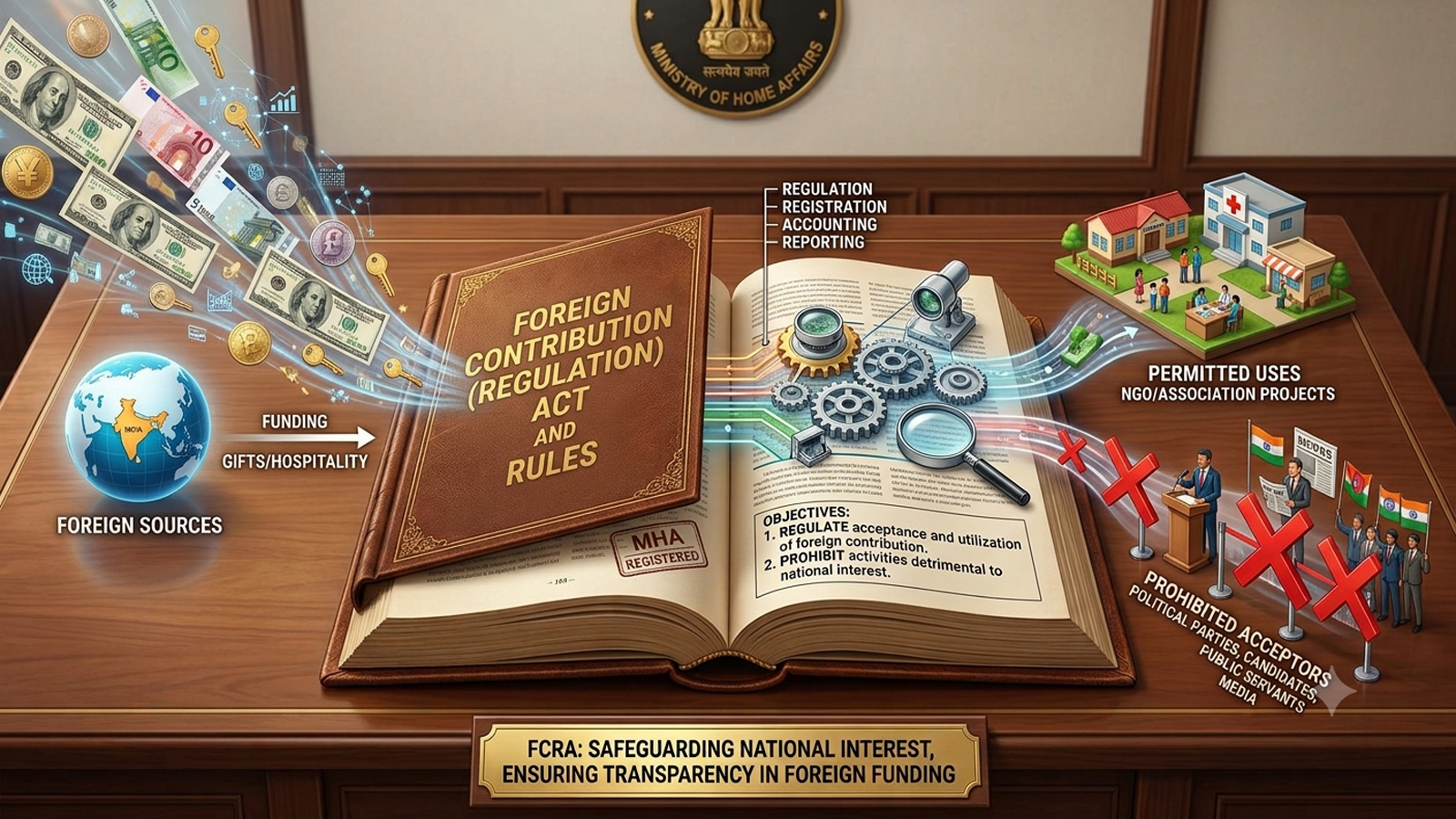
The Ministry of Home Affairs has clarified that the Foreign Contribution (Regulation) Act (FCRA) is designed to facilitate legitimate international cooperation by allowing registered organisations to receive foreign contributions for a wide range of developmental, charitable and humanitarian activities.
According to the Ministry, the Act provides a legal framework that enables foreign funding while ensuring that contributions are received, utilised and accounted for in accordance with Indian law. Organisations receiving foreign contributions are required to obtain registration or prior permission, receive funds through a designated bank account and utilise them only for declared purposes. No more than 20 per cent of annual foreign contributions may be spent on administrative expenses, while annual audited disclosures are mandatory.
The Ministry has identified several sectors in which foreign contributions may be legitimately utilised under the FCRA. These include education, healthcare, rural development, social welfare, environmental conservation, cultural preservation, disaster relief, faith-based welfare and scientific research.
In the education sector, foreign funding may support schools, colleges, vocational training, scholarship programmes, educational research, libraries and adult literacy initiatives. Healthcare-related activities include hospitals, clinics, mobile health units, maternal and child healthcare, disability support and community health education.
Foreign contributions may also be utilised for rural development projects such as watershed development, sanitation, clean water access, livelihood support, agricultural extension and housing. Social welfare programmes benefiting persons with disabilities, women, children and senior citizens are similarly eligible for funding.
Environmental initiatives permitted under the Act include afforestation, clean energy, pollution control, wildlife conservation and environmental research, while cultural and heritage projects may cover preservation of folk arts, museums, archives, indigenous knowledge and traditional crafts.
The framework also allows foreign contributions for disaster relief, rehabilitation and emergency response. Faith-based organisations may receive foreign funding for maintenance of places of worship, religious education, moral instruction, meditation programmes and preservation of faith traditions. Scientific research institutions, laboratories, academic collaborations and knowledge dissemination activities also remain eligible under the Act.
According to the Ministry, the FCRA seeks to ensure that foreign funding supports genuine developmental work while maintaining transparency and accountability through a structured regulatory framework.