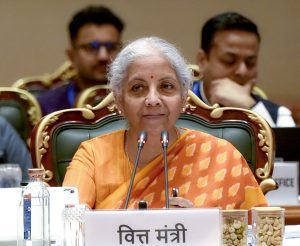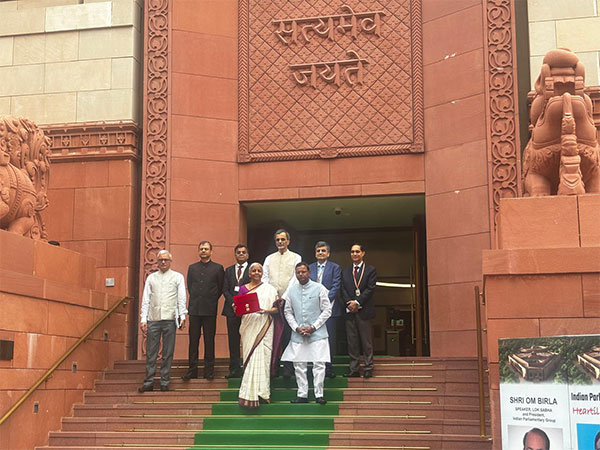
Finance Minister Nirmala Sitharaman arrived in Parliament to present the Union Budget for 2024-25.
Earlier, Sitharaman met President Droupadi Murmu at Rashtrapati Bhavan, ahead of the Budget presentation at 11 am.
The Finance Minister left the North Block offices of the Finance Ministry with a copy of the Union Budget 2024-25 which as has been tradition, is in a digital format.
The Finance Minister along with her team posed for a photo opportunity along with the red ‘Bahi Khatha’ digital tablet before they left for Rashtrapati Bhavan.
This would mark Sitharaman’s seventh consecutive budget and eclipsing the late Moraji Desai’s record of six consecutive budgets, which is likely to focus on changes in the income tax structure and improving the ease of doing business in India.
Speaking to the media, Minister of State for Finance Pankaj Chaudhary earlier said that the first Union Budget of the third Modi government will be based on his mantra of “Sabka Saath Sabka Vikas”.
The budget session of Parliament began on July 22 and, according to schedule, will end on August 12.
On Monday, The economic survey presented in the Parliament by finance minsiter Nirmala Sithraman says in the medium term Indian economy can grow at a rate of 7 per cent. The economic survey stated, “In the medium term, the Indian economy can grow at a rate of 7 per cent plus on a sustained basis if we build on the structural reforms undertaken over the last decade. This requires a tripartite compact between the Union Government, State Governments and the private sector.”
The survey further added that India faces a unique blend of opportunities and challenges amid global trends such as geo-economic fragmentation, a push for self-reliance, looming climate change, the rise of technology, and limited policy space.
It suggested that the government’s focus must shift to bottom-up reforms and strengthening governance to ensure that the structural reforms of the past decade result in strong, sustainable, balanced, and inclusive growth.
According to the Survey, the growth strategy for the medium term, termed “Amrit Kaal,” hinges on six critical areas. First, there must be a deliberate focus on boosting private investment. Second, the growth and expansion of India’s MSMEs (Mittelstand) should be a strategic priority. Third, the potential of agriculture as an engine of future growth must be recognized, with policy impediments removed. Fourth, securing the financing of India’s green transition is essential. Fifth, bridging the education-employment gap is necessary. Finally, focused building of state capacity and capability is required to sustain and accelerate India’s progress.
(ANI)