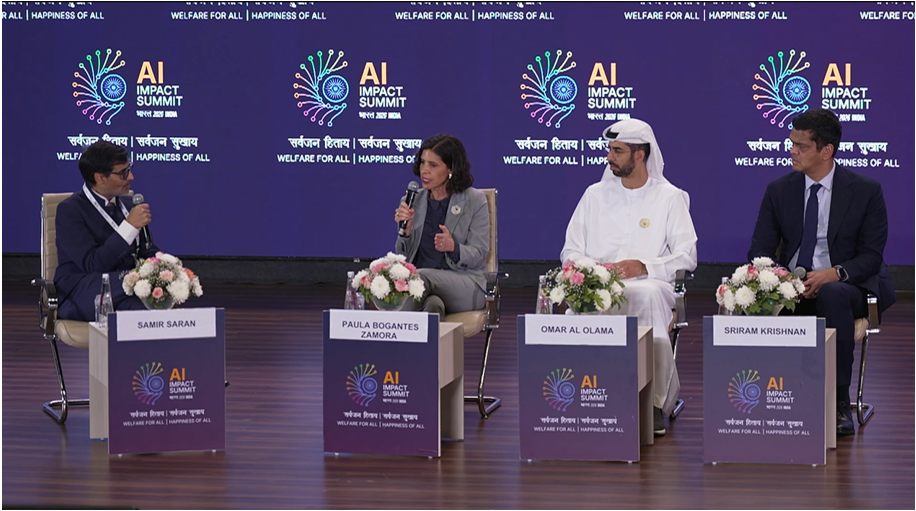
Senior officials from the United States, United Arab Emirates and Costa Rica on Thursday outlined national approaches to artificial intelligence that prioritise infrastructure expansion, innovation, responsible regulation and multilateral cooperation, during a high-level panel at the India AI Impact Summit 2026.
The discussion examined AI diffusion, national strategies for building capability and the evolving framework for global governance, featuring Paula Bogantes Zamora, Minister of Science, Innovation, Technology and Telecommunications of Costa Rica; FO Omar Al Olama, Minister of State for Artificial Intelligence, Digital Economy and Remote Work Applications of the United Arab Emirates; Sriram Krishnan, Senior Policy Advisor for AI at the White House; and Dr. Samir Saran, President of the Observer Research Foundation, who moderated.
Sriram Krishnan detailed the United States’ AI priorities around three pillars: developing world-class infrastructure, fostering innovation, and deepening partnerships with allies. He stressed the need to expand data centre capacity and computing resources while maintaining affordability and energy sustainability. Krishnan emphasised that innovation should not be hampered by excessive bureaucracy and called for clear, predictable regulation that protects critical areas such as child safety, intellectual property and national security. He highlighted international collaboration on technology sharing and secure supply chains to advance shared AI capabilities worldwide.
Omar Al Olama presented the UAE’s vision of AI as a means to enhance quality of life and deliver widespread societal benefits. He said AI diffusion requires infrastructure readiness, AI literacy and responsible deployment across society. As the world’s first Minister of AI, Al Olama underscored the value of sustained global dialogue and inclusive governance platforms. He warned against sudden regulatory extremes and advocated gradual, proactive, adaptive frameworks that evolve with technology. Drawing from past technological shifts, he called for continuous, consultative regulation that balances innovation with safeguards and ensures every nation participates in the global AI conversation.
Paula Bogantes Zamora offered insights from smaller and developing economies, noting that AI forces countries to assess their digital readiness honestly. She identified foundational needs including connectivity such as 5G rollout, national AI strategies, data governance and investment in research and innovation. Bogantes Zamora pointed to disparities in innovation spending and infrastructure across regions and said regulation must align with each country’s development stage. She advocated regional cooperation and like-minded groupings to strengthen collective voices and negotiating power. Stressing data as a critical asset, she urged deeper global discussions on data valuation, equitable access to AI tools and support for building core capabilities before advancing to sophisticated AI solutions.
Moderating the session, Dr. Samir Saran framed the conversation around impact, diffusion and multilateralism. He highlighted the need to balance innovation with restraint, addressing safety, guardrails and human-centric design. The dialogue explored how regional, thematic or values-based partnerships can keep AI governance inclusive and responsive amid rapid technological change.
The panel concluded that AI presents a major opportunity for economic growth, societal advancement and better quality of life. Participants agreed that sustained investment in infrastructure, enabling innovation, responsible regulation and stronger global cooperation are essential to ensure AI delivers benefits at scale for humanity.
The session reinforced the India AI Impact Summit 2026 as a leading international platform for shaping safe, inclusive and forward-looking AI governance.