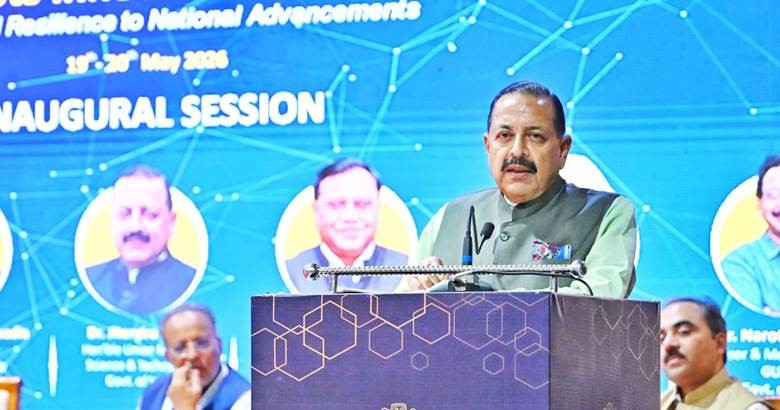
Union Minister Jitendra Singh on Tuesday said promoting grassroots innovators can strengthen India’s rural economy and help reduce regional imbalances by driving inclusive, innovation-led growth.
Addressing the inaugural session of the two-day National Workshop on “Grassroots Innovation Pathways: From Local Resilience to National Advancements” at Science City in Ahmedabad, Gujarat, the minister described grassroots innovators as India’s “silent nation builders” whose contributions often remain outside formal institutional frameworks despite their significant social and economic impact.
Jitendra Singh said innovation in India should not remain confined to metropolitan centres, laboratories or elite institutions, but must extend to villages, small towns and community ecosystems. He stressed that grassroots innovators should become active participants in India’s economic transformation, noting that their traditional knowledge, local skills and practical innovations hold immense potential for livelihood generation, decentralised development and national progress.
The workshop was organised by NITI Aayog in collaboration with the National Innovation Foundation (NIF) and the Gujarat Council of Science and Technology (GUJCOST). Among those present were Gujarat Science and Technology Minister Rushikesh Patel, former DRDO Chairman and former NITI Aayog member Dr. V.K. Saraswat, and senior policymakers, scientists and innovators from across the country.
Highlighting India’s ability to innovate under resource constraints, the minister referred to the early years of the country’s space programme and recalled how pioneers such as Dr. Vikram Sarabhai worked with limited infrastructure but exceptional commitment. He said many grassroots innovators may lack formal academic qualifications but possess remarkable creativity and technical expertise rooted in practical experience.
Singh noted that an increasing number of startups are emerging from Tier-2 and Tier-3 cities, reflecting the growing innovation potential of smaller towns and rural India. He emphasised that grassroots innovation is a bottom-up process and called for stronger linkages between local innovators and scientific institutions, modern technology, validation systems and market opportunities.
He said the challenge is not merely identifying innovators but creating pathways to scale their ideas into viable products and community-driven solutions. Stressing the economic importance of grassroots innovation, he said India cannot emerge as a leading global economy unless rural economies are strengthened and growth becomes regionally balanced.
The minister also advocated stronger convergence between grassroots innovators and formal innovation ecosystems, including research institutions, incubators and industry. He observed that several government schemes and scientific programmes fail to adequately reach local innovators due to a disconnect from grassroots realities.
On technology integration, Jitendra Singh said blending traditional knowledge systems with modern technologies such as artificial intelligence and food processing can significantly enhance the value and marketability of local products and skills. He cited examples involving millet-based products and traditional regional food items where scientific interventions improved commercialisation and income opportunities for local communities.
He further said Prime Minister Narendra Modi has consistently promoted grassroots innovation and community participation through initiatives such as PM Vishwakarma and “Mann Ki Baat”, which aim to preserve traditional skills while linking them with technology, entrepreneurship and economic opportunities.
The workshop features sessions on institutional support for grassroots innovation, community-driven initiatives, regional innovation models and lessons from grassroots innovators. Discussions are expected to focus on policy frameworks, institutional coordination, incubation support and scalable approaches to expanding grassroots innovation across the country.
Singh expressed confidence that such initiatives would help create a stronger and more connected innovation ecosystem, enabling innovators from villages and remote regions to play an equal role in India’s development journey and contribute towards the vision of Viksit Bharat @2047.