






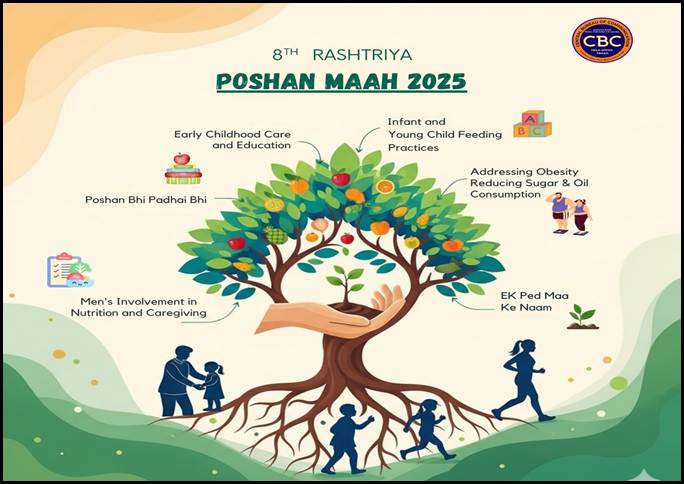
Prime Minister Narendra Modi launched the 8th Rashtriya Poshan Maah on September 17, 2025, along with the Swasth Nari Sashakt Parivar Abhiyan, marking a renewed push for nutrition-centric development in line with his vision of Sashakt Nari, Suposhit Bharat. The initiative, which has become a nationwide movement since its inception in 2018, seeks to place nutrition at the heart of India’s development agenda, targeting children under six, adolescent girls, pregnant women, and lactating mothers through a technology-driven and community-based approach.
Poshan Abhiyaan, officially known as the Prime Minister’s Overarching Scheme for Holistic Nourishment, was first launched on March 8, 2018, in Jhunjhunu, Rajasthan. The programme aims to tackle malnutrition by promoting dietary diversity, complementary feeding, exclusive breastfeeding, and community participation under its Jan Andolan strategy. September, celebrated as Poshan Maah each year, is dedicated to spreading nutrition awareness, coinciding with the Prime Minister’s birthday month and reflecting his personal commitment to health and well-being as a foundation for national progress.
Speaking at the launch, PM Modi urged citizens to share locally nutritious recipes via platforms like MyGov using the hashtag #Local4Poshan, promoting traditional and regional food diversity. He also emphasised the need to address emerging challenges such as obesity, urging families to adopt healthier cooking practices by using less oil and sugar. “Obesity is becoming a big problem for our country. In the coming years, every third person will be affected by it. Therefore, I would like to give you a small suggestion: use 10% less oil in cooking,” he said during his Independence Day address earlier this year.
The 8th edition of Poshan Maah aligns closely with the National Education Policy 2020 by integrating nutrition with early childhood education through initiatives like Poshan Bhi Padhai Bhi, which seeks to develop the world’s largest high-quality preschool network at Anganwadi Centres. Environmental sustainability has also been woven into the campaign through tree plantation drives under the Ek Ped Maa Ke Naam initiative. Additionally, this year’s programme places a renewed emphasis on men’s involvement in caregiving and nutrition awareness to create shared responsibility within households and communities.
Technology remains a cornerstone of the Poshan Abhiyaan. The Poshan Tracker app, launched in March 2021, has registered over 9.14 crore beneficiaries and 14.02 lakh Anganwadi Centres, enabling real-time monitoring of child growth indicators and efficient service delivery by Anganwadi workers.
Complementing the Abhiyaan, the PM POSHAN Scheme – previously known as the Mid-Day Meal Scheme – continues to provide hot cooked meals to over 11.8 crore students across 11.2 lakh schools. With a financial outlay of ₹1.3 lakh crore for 2021-26, the scheme not only improves nutritional outcomes but also boosts school attendance. The Ministry of Education recently approved a 9.5% increase in the material cost component, accounting for food price inflation and adding ₹954 crore to the central government’s expenditure for FY 2025–26.
To deepen public engagement, Poshan Maah is complemented by Poshan Pakhwada, observed in March–April each year. The 2025 edition highlighted the importance of the first 1,000 days from conception to age two, a crucial window for preventing stunting, anaemia, and low birth weight, and for ensuring lifelong health and productivity.
Adding an innovative dimension to nutrition education, the Children Nutrition Park near the Statue of Unity in Gujarat continues to inspire children with its interactive exhibits, Nutri Train rides, and digital games designed to encourage healthy eating habits under the theme Sahi Poshan, Desh Roshan.
Over the years, Poshan Maah has evolved into a true people’s movement, engaging millions of citizens through rallies, recipe-sharing campaigns, nutrition workshops, and community events. By combining grassroots participation, technology-driven monitoring, and inter-ministerial convergence, the initiative aims to break the intergenerational cycle of malnutrition and build a healthier, stronger India.