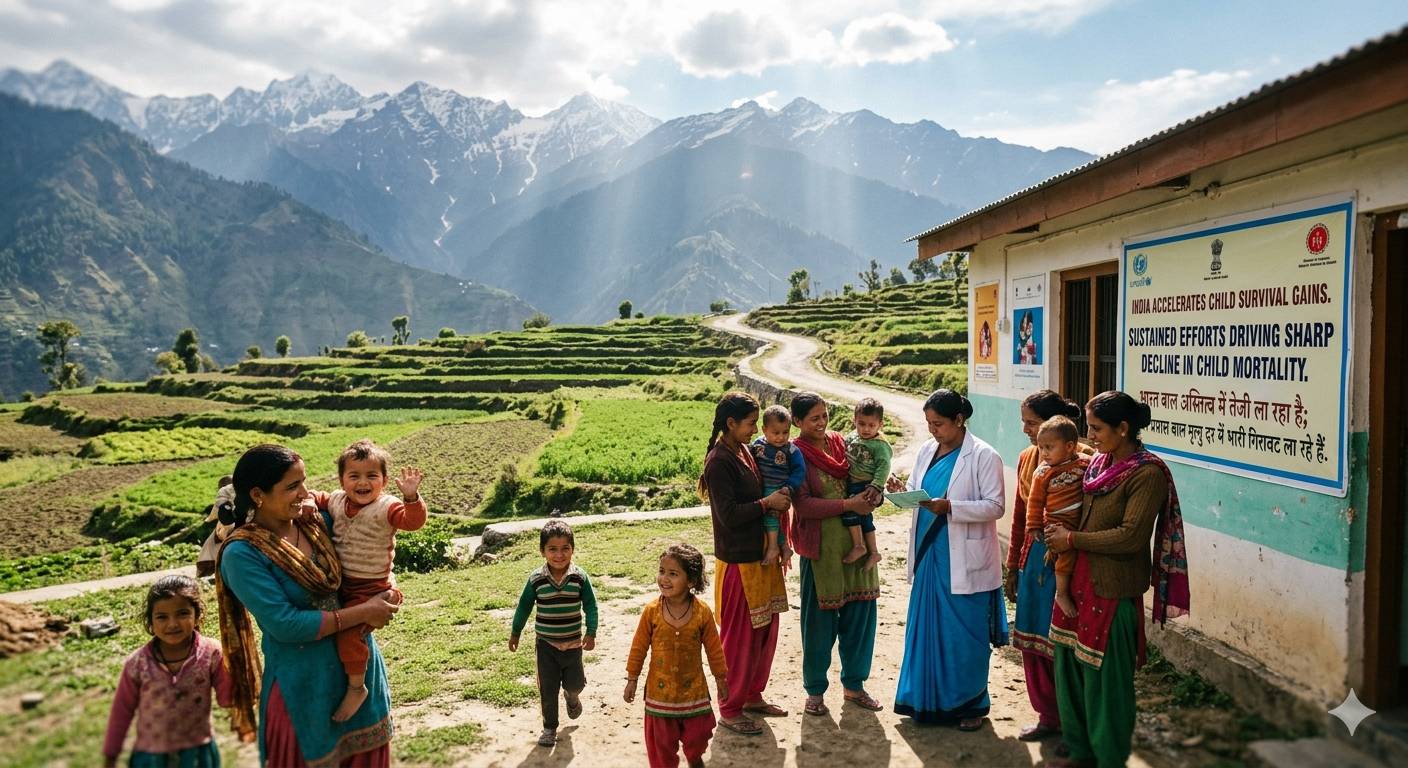
India has emerged as a key contributor to global progress in reducing child mortality, according to the latest United Nations Inter-agency Group for Child Mortality Estimation (UNIGME) Report 2025. The report highlights India’s sustained and large-scale efforts in improving child survival outcomes, particularly across neonatal and under-five mortality indicators.
Over the past two decades, India has played a pivotal role in reducing child mortality in the Southern Asia region, which has witnessed a 76% decline in under-five deaths since 1990 and 68% decline since 2000. This sharp reduction is largely driven by countries like India through targeted public health interventions, improved institutional delivery systems, and expanded immunization coverage.
The region’s under-five mortality rate has fallen significantly—from 92 deaths per 1,000 live births in 2000 to nearly 32 in 2024, reflecting sustained progress in child health outcomes.
India’s focused interventions have contributed to reducing deaths caused by preventable conditions such as: Pneumonia, Diarrhoea, Malaria and Birth-related complications.
The report underscores that a majority of child deaths are preventable or treatable, and India’s scaling up of interventions such as: Universal Immunization Programme (UIP), Facility-based newborn care, Integrated Management of Neonatal and Childhood Illnesses (IMNCI) has significantly improved survival rates.
India’s improvements in neonatal care systems have been particularly impactful. Across Southern Asia: Neonatal deaths declined by nearly 60% since 2000 and Mortality in children aged 1–59 months declined by over 75%.
This reflects India’s emphasis on:
Skilled birth attendance, Strengthening Special Newborn Care Units (SNCUs), Expanding antenatal and postnatal care.
While Southern Asia still accounts for nearly 25% of global under-five deaths, the region has made one of the fastest reductions globally, positioning India as a leader among high-burden countries.
India’s success demonstrates that targeted, large-scale, and equity-driven interventions can deliver rapid results, even in populous and diverse settings.
Addressing Emerging Challenges
The report also highlights emerging priorities where India is actively focusing:
Tackling neonatal mortality, which now constitutes a larger share of under-five deaths
Addressing prematurity and birth complications, which remain leading causes
Bridging urban-rural and inter-state disparities
India remains committed to achieving the Sustainable Development Goal (SDG) targets:
Under-five mortality rate below 25 per 1,000 live births
Neonatal mortality rate below 12 per 1,000 live births
With accelerated interventions, India is well-positioned to further reduce preventable deaths and contribute significantly to global child survival goals.
India’s progress stands as a strong example of how policy prioritization, scale, and sustained public health efforts can drive transformative outcomes. As global progress slows, India’s momentum offers both hope and a replicable model for other nations.
India has made remarkable progress in improving child survival outcomes, as highlighted in the latest UN Inter-agency Group for Child Mortality Estimation (UNIGME) report. The Neonatal Mortality Rate (NMR) has declined by nearly 70%—from 57 deaths per 1,000 live births in 1990 to 17 in 2024—reflecting sustained improvements in maternal and newborn healthcare services. Similarly, the Under-5 Mortality Rate (U5MR) has registered an even steeper reduction of 79%, falling from 127 in 1990 to 27 in 2024. These gains underscore the impact of strengthened health systems, expanded immunization coverage, institutional deliveries, and targeted child health interventions, positioning India as a significant contributor to global reductions in child mortality.