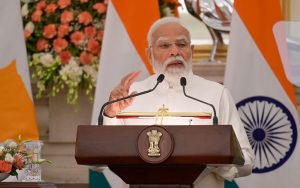
India and Israel on Thursday agreed to elevate their bilateral relationship to a “Special Strategic Partnership for Peace, Innovation and Prosperity” during PM Modi’s state visit to Israel, marking a significant expansion of cooperation across defence, technology, trade and people-to-people ties, a joint statement said.
The Indian prime minister is in Israel at the invitation of Israeli Prime Minister Benjamin Netanyahu, accompanied by a high-level delegation of senior ministers and officials. Recalling PM Modi’s historic visit to Israel in 2017 and Netanyahu’s visit to India in 2018, the leaders said those engagements had laid the foundation for a new phase of partnership, noting substantial progress since then across emerging technologies, cybersecurity, agriculture, water management, health, defence and security.
The two prime ministers said the upgraded partnership would be anchored in a shared vision of peace, security and prosperity driven by innovation and entrepreneurship. They highlighted the complementarity between Israel’s position as a global hub of technology and innovation and India’s strengths in talent, manufacturing and entrepreneurship, and agreed to integrate capabilities in artificial intelligence, cybersecurity, semiconductors, quantum computing, biotechnology, agriculture and water management, defence platforms and space exploration. The leaders said the partnership would contribute to India’s goal of becoming a developed nation by 2047 while delivering shared technological and economic gains.
To ensure that policy priorities translate into measurable outcomes, the leaders stressed the need to institutionalise cooperation through structured government-to-government, business-to-business and people-to-people mechanisms.
In defence and security, the prime ministers welcomed the Memorandum of Understanding on Defence Cooperation signed on November 4, 2025, and agreed on a forward-looking roadmap to deepen collaboration in scope and scale. They also underlined the importance of closer coordination in critical and emerging technologies, welcoming a new initiative led by the national security advisers of both countries to align strengths in niche and future technologies.
Reviewing progress in science and innovation, the leaders reaffirmed the role of the India–Israel Industrial R&D and Innovation Fund and agreed to strengthen its implementation through greater industry outreach and high-quality joint research partnerships. They also agreed to increase funding under the India–Israel Joint Research Calls from $1 million to $1.5 million each, expand scientific exchanges and elevate the Joint Commission on Science and Technology to the ministerial level.
The prime ministers emphasised the importance of stronger academia–industry linkages, institutional support for joint innovation and deeper cooperation in artificial intelligence, including talent development. They welcomed the signing of a memorandum of understanding on cooperation in AI and agreed to expand collaboration in this field for public welfare.
In space cooperation, the leaders welcomed ongoing collaboration between the Israel Space Agency and the Indian Space Research Organisation, encouraging closer engagement between start-ups and space industries in both countries. They also welcomed a declaration of intent to establish a Horizon Scanning and Strategic Foresight Mechanism to identify emerging global trends using data, artificial intelligence and expert inputs.
On cybersecurity, the leaders reaffirmed their commitment to strengthening cooperation in both government and private sectors. They agreed to develop a multi-year strategic programme covering capacity building, applied research, security-by-design principles and regular joint exercises, and welcomed the signing of a letter of intent to establish an India–Israel Centre of Excellence in Cybersecurity in India.
Turning to trade and investment, PM Modi and Netanyahu said unlocking the full potential of economic ties was a priority. They welcomed the India–Israel Bilateral Investment Agreement signed in September 2025 and the launch of negotiations for a free trade agreement, instructing negotiating teams to expedite talks for an early conclusion. They also welcomed cooperation in the financial-cyber domain, discussed linking India’s Unified Payments Interface with Israel’s fast payment system, and noted the signing of an MoU between NPCI International and MASAV to examine cross-border payment linkages.
The leaders highlighted the importance of expanding direct air connectivity between Tel Aviv and major Indian cities and encouraged airlines from both countries to begin direct operations. They also welcomed the launch of the India–Israel Financial Dialogue and encouraged greater Indian participation in Israel’s infrastructure projects.
In agriculture and water, the leaders reaffirmed cooperation in water conservation, wastewater reuse, desalination and agricultural innovation, reviewing progress at centres of excellence operating across India. They welcomed new agreements on fisheries, aquaculture, environmental protection and climate action aimed at promoting sustainable development and technology transfer.
The prime ministers strongly condemned terrorism in all its forms, including cross-border terrorism, and condemned the October 7, 2023 attack on Israel, the April 22, 2025 attack on Indian tourists in Pahalgam, and the November 10, 2025 incident near Red Fort in New Delhi. They reiterated their commitment to global peace and security and welcomed U.S. President Donald Trump’s “Comprehensive Plan to End the Gaza Conflict,” while underscoring the need for a just and durable peace through dialogue.
They also welcomed steps to deepen parliamentary cooperation, expand cultural and people-to-people exchanges, and strengthen frameworks governing the mobility, safety and legal rights of Indian workers in Israel. The leaders agreed that up to 50,000 additional Indian workers could arrive in Israel over the next five years.
In health and education, the leaders agreed to convene the first joint working group on health in early 2026, deepen cooperation on healthcare innovation and digital transformation, and expand academic collaboration through university partnerships, exchanges and a new India–Israel Academic Cooperation Forum.
The leaders also discussed regional and global connectivity initiatives, including the I2U2 partnership and the India–Middle East–Europe Economic Corridor, and welcomed the signing of 16 agreements spanning artificial intelligence, cybersecurity, education, culture, agriculture, mining, maritime heritage, fisheries, worker mobility, payments, arbitration and financial regulation.
PM Modi and Netanyahu reaffirmed their commitment to sustained high-level engagement, saying the enhanced partnership reflected a shared determination to build an enduring India–Israel relationship grounded in innovation, collaboration and long-term prosperity.