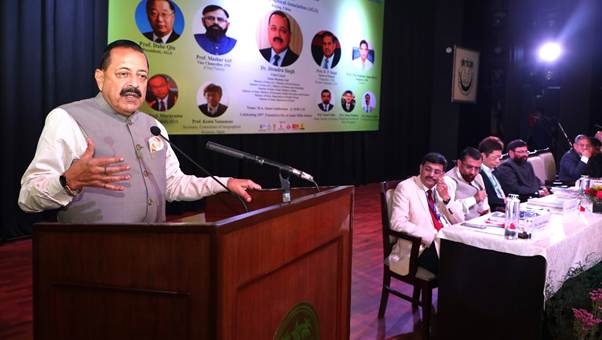

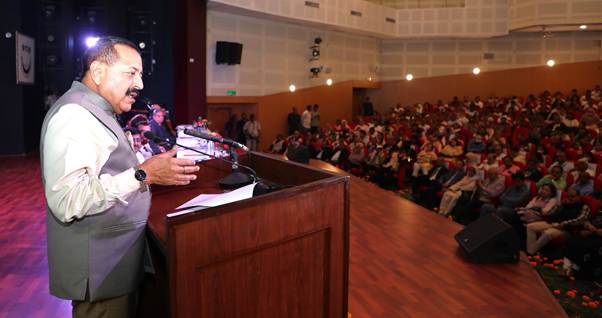
Union Minister of Science and Technology Dr. Jitendra Singh on Thursday called for a people-led movement to tackle climate change, stressing the need for synergy between policy, technology, and youth-driven innovation to ensure sustainable urban futures.
Delivering the inaugural address at the Asian Conference on Geography (ACG 2025) at Jamia Millia Islamia, Dr. Singh said the meet was both “timely and crucial” as it focuses on the deeply interconnected issues of climate change, urbanization, and resource management that shape the sustainability of the planet.
The Minister said India has emerged as a global leader in linking economic growth with environmental sustainability, guided by Prime Minister Narendra Modi’s vision of achieving net-zero emissions by 2070 and promoting the LiFE (Lifestyle for Environment) movement for living in harmony with nature.
Lauding Jamia Millia Islamia for hosting the first-ever edition of ACG in India, Singh commended Vice-Chancellor Prof. Mazhar Ali and the organizers for bringing together international experts, academics, and students to deliberate on shared challenges.
Highlighting Asia’s central role in global transformation, he noted that the region—while driving economic dynamism—also contributes over half of the world’s greenhouse gas emissions. Citing the IPCC’s Sixth Assessment Report, he warned of growing vulnerability to extreme weather events such as floods, heatwaves, and water scarcity if current emission levels persist.
Singh pointed out that over 750 million people in South Asia are exposed to severe climate hazards, from Himalayan glacier melt to coastal flooding and urban heat islands. He named Delhi, Dhaka, Bangkok, and Manila as among the world’s most climate-vulnerable megacities projected by 2050.
He cautioned that while urbanization reflects progress, unplanned expansion, encroachment on floodplains, groundwater depletion, and rising pollution have made cities more fragile. Recalling the 2014 Srinagar floods, he said such disasters are often aggravated by human negligence and poor planning.
The Minister shared that nearly 80% of wastewater in developing Asian countries is released untreated and that urban India alone generates over 55 million tonnes of solid waste annually—growing at around 5% each year. He said waste-to-wealth and circular economy initiatives are vital for sustainable development, citing examples from Dehradun where used cooking oil recycling has created both environmental and income benefits.
Emphasizing public participation, Singh said no government initiative can succeed without people’s involvement. “Unless there is a social movement, no amount of policy or seminar will yield optimal results,” he said, crediting the Swachh Bharat Mission’s success to citizens’ behavioural change.
He outlined India’s policy framework for sustainability, including the National Action Plan on Climate Change (NAPCC), State Action Plans, Smart Cities Mission, AMRUT, and Swachh Bharat Mission. He said these reflect India’s commitment to embedding sustainability into governance and urban planning.
Singh added that India’s initiatives—ranging from Green Hydrogen and Bio-Economy to the Circular Economy and Digital India—demonstrate the country’s determination to harmonize growth with ecological balance. He also underlined the contribution of science and innovation, noting ISRO’s Earth Observation Missions, the National Geospatial Policy (2022), and drone-based mapping under the SVAMITVA programme as crucial tools for climate resilience.
Calling education and youth central to the sustainability agenda, Singh referred to the National Education Policy (NEP) 2020, which enables students to engage with interdisciplinary learning and environmental awareness. With over 70% of India’s population below 40, he said, “the language of climate action must be the language of youth—digital, creative, and inspiring.”
Singh also called for using social media and short digital content to promote sustainable practices, remarking that even small steps like collecting used oil can create economic and ecological value when scaled.
Highlighting India’s leadership in global climate cooperation, he cited the International Solar Alliance (ISA) and the Coalition for Disaster Resilient Infrastructure (CDRI) as key examples of partnerships driving low-carbon growth.
Singh concluded by thanking Jamia Millia Islamia for organizing the conference and said such platforms are essential for advancing academic collaboration and youth engagement on environmental challenges. “Climate is not just the concern of policymakers or scientists,” he said. “It is a personal concern for every citizen—for our own health, our well-being, and our children’s future.”