











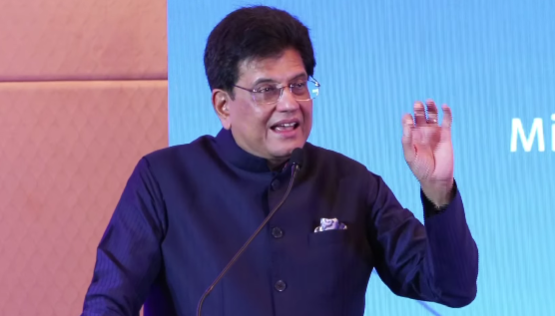
The proposed India–Oman Free Trade Agreement (FTA) is expected to unlock major opportunities across a wide range of sectors, including textiles, food processing, automobiles, gems and jewellery, agrochemicals, renewable energy and auto components, Union Minister of Commerce and Industry Piyush Goyal said on Wednesday.
Addressing the India–Oman Business Forum in Muscat, the Minister said Oman’s strategic location offers Indian businesses enhanced access to markets across the Gulf Cooperation Council (GCC), Eastern Europe, Central Asia and Africa, positioning the country as a vital gateway for regional trade.
Oman’s Minister of Commerce, Industry and Investment Promotion, Qais Al Yousef, said India has emerged as Oman’s third-largest trading partner, while Oman continues to be a key destination for Indian investments. He noted that Indian investments in Oman have more than tripled since 2020 to reach USD 5 billion, spanning sectors such as green steel, green ammonia, aluminium manufacturing and logistics. He said these investments reflect India’s confidence in Oman as a long-term operating base.
Highlighting the forthcoming FTA as a major milestone in bilateral ties, Shri Goyal said it would be the first free trade agreement entered into by Oman in nearly two decades. He also recalled the centuries-old maritime links between the two countries, including historical trade through ports such as Lothal, underscoring the deep-rooted nature of India–Oman relations.
The Minister said the upcoming visit of Prime Minister Narendra Modi to Oman coincides with the completion of 70 years of diplomatic relations between the two nations. He also recalled India’s decision to invite Oman as a special guest during its G20 Presidency in 2023, reflecting the strong mutual trust and strategic partnership between the two countries.
Goyal underlined significant scope for cooperation in services such as professional services, accounting, business process re-engineering, research and development, tourism, healthcare and education. He identified four priority areas for future collaboration: energy transition, including green hydrogen and renewable energy; infrastructure development, including ports and multimodal logistics; food security through cold chains and food parks; and collaboration between startup ecosystems, particularly in deep tech, logistics and artificial intelligence.
Referring to the shared focus on youth-led growth, the Minister said India’s vision of Viksit Bharat 2047 aligns closely with Oman’s Vision 2040. He said the demographic strength and entrepreneurial energy in both countries provide a strong foundation for sustained economic cooperation.
Expressing confidence in the future of bilateral ties, Goyal said the India–Oman partnership, built on trust, shared history and complementary strengths, is poised to enter a new phase of growth, with businesses from both sides working together to fully realise the opportunities ahead.







