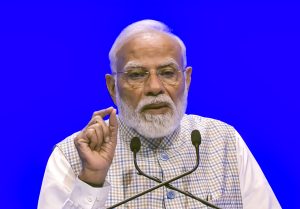
Union Minister Pralhad Joshi said on Sunday that India is making rapid progress in renewable energy and is on track to achieve the ambitious target of producing 5 million metric tonnes of green hydrogen by 2030.
Speaking at the Panchjanya Infra Confluence 2025, Joshi said Prime Minister Narendra Modi never sets easy goals for himself or his cabinet colleagues, and has outlined a challenging roadmap for the renewable energy sector.
“The Prime Minister does not set easily achievable targets for himself or for any of us; he prefers goals that push us to strive harder. In the renewable energy sector too, he has set a very ambitious goal. In line with that, we have already achieved fifty percent so far,” Joshi said.
He added, “We are firmly on course to achieve our ambitious target of 5 million metric tonnes of green hydrogen production by 2030.”
Joshi, who also serves as the Union Minister of New and Renewable Energy, had earlier addressed the Annual Green Hydrogen R&D Conference this month. The National Green Hydrogen Mission (NGHM), launched in 2023, is aimed at transforming India’s energy landscape and positioning the country as a global hub for green hydrogen.
With an outlay of ₹19,744 crore, the Mission is built on four pillars: Policy and Regulatory Framework, Demand Creation, R&D and Innovation, and Enabling Infrastructure. Dedicated hydrogen hubs are being developed at Kandla, Paradip, and Tuticorin ports to enhance India’s export competitiveness.
Large enterprises such as NTPC, Reliance, and IOCL, along with start-ups and MSMEs, are making significant investments in hydrogen, creating a strong value chain and generating lakhs of new jobs.
The NGHM targets 5 million metric tonnes of green hydrogen production annually by 2030, 125 GW of new renewable capacity, investments worth ₹8 lakh crore, six lakh new jobs, and a reduction of 50 million tonnes of CO₂ emissions each year.
India has already achieved 50% of its installed electricity capacity from non-fossil fuel sources, five years ahead of the target set under its Nationally Determined Contributions (NDCs) to the Paris Agreement. This milestone, Joshi said, reflects the country’s ambition, innovation, and commitment to sustainable development.
He noted that India is advancing on a bold, inclusive, and technology-driven path toward achieving 500 GW of non-fossil capacity by 2030 and net-zero emissions by 2070.
-ANI