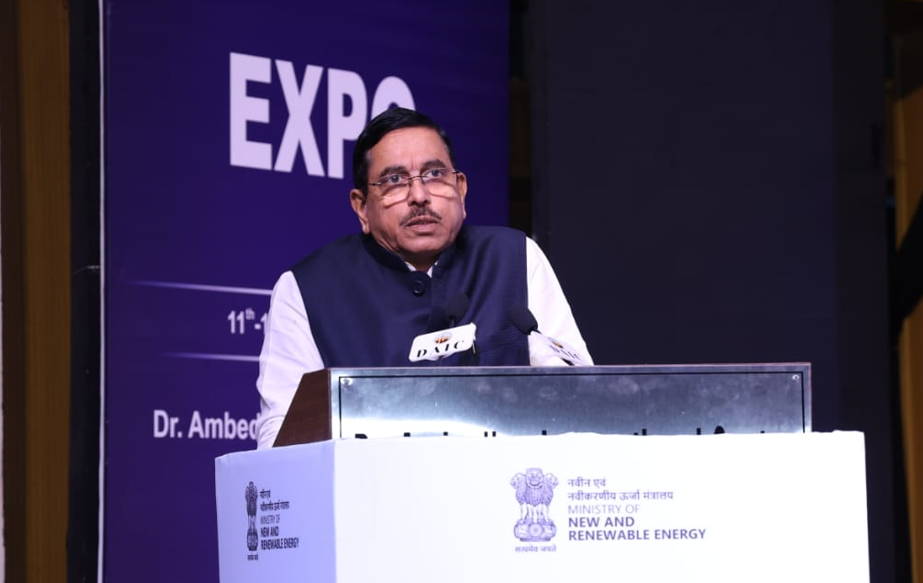
India’s 2030 vision of achieving 500 GW of non-fossil capacity is already more than halfway achieved, with the country crossing 251.5 GW of non-fossil capacity, said Union Minister for New and Renewable Energy Pralhad Joshi on Thursday.
Joshi also said that India is firmly moving towards building a complete Swadeshi solar value chain, with the target of achieving indigenous solar cell manufacturing by 2028.
Speaking at the ‘State Review Meeting on Renewable Energy’ organised by the Ministry of New and Renewable Energy, he said the country is now advancing beyond modules to develop domestic capacity for wafers and ingots as well, ensuring that the entire solar manufacturing ecosystem is established within the country.
The minister said this step will not only reduce import dependence but also generate employment, boost investment, and strengthen India’s position as a global leader in clean energy manufacturing.
He appreciated the remarkable efforts of states in advancing renewable energy initiatives, noting that these contributions are strengthening India’s position as a global leader in the sector.
Joshi termed the achievements a testament to the visionary leadership of Prime Minister Narendra Modi, which transformed India’s clean energy growth and domestic manufacturing in renewable energy (RE) sector, and is accelerating the march towards Viksit Bharat.
Highlighting key schemes, the minister said that nearly 20 lakh households have already benefitted under the PM Surya Ghar Muft Bijli Yojana.
He urged states and discoms to ensure strict quality compliance, finalise agreements without delay, and offer the best possible tariff credits to consumers.
On the PM-KUSUM scheme, he noted that after initial reluctance, the scheme has now gained strong momentum across states, with demand for additional allocations from Chief Ministers. He announced that the second phase of PM-KUSUM will be launched after the present phase ends in March 2026.
The minister underlined that India has also achieved the milestone of 50 per cent of installed electricity capacity from non-fossil fuel sources five years ahead of schedule.
(IANS)