







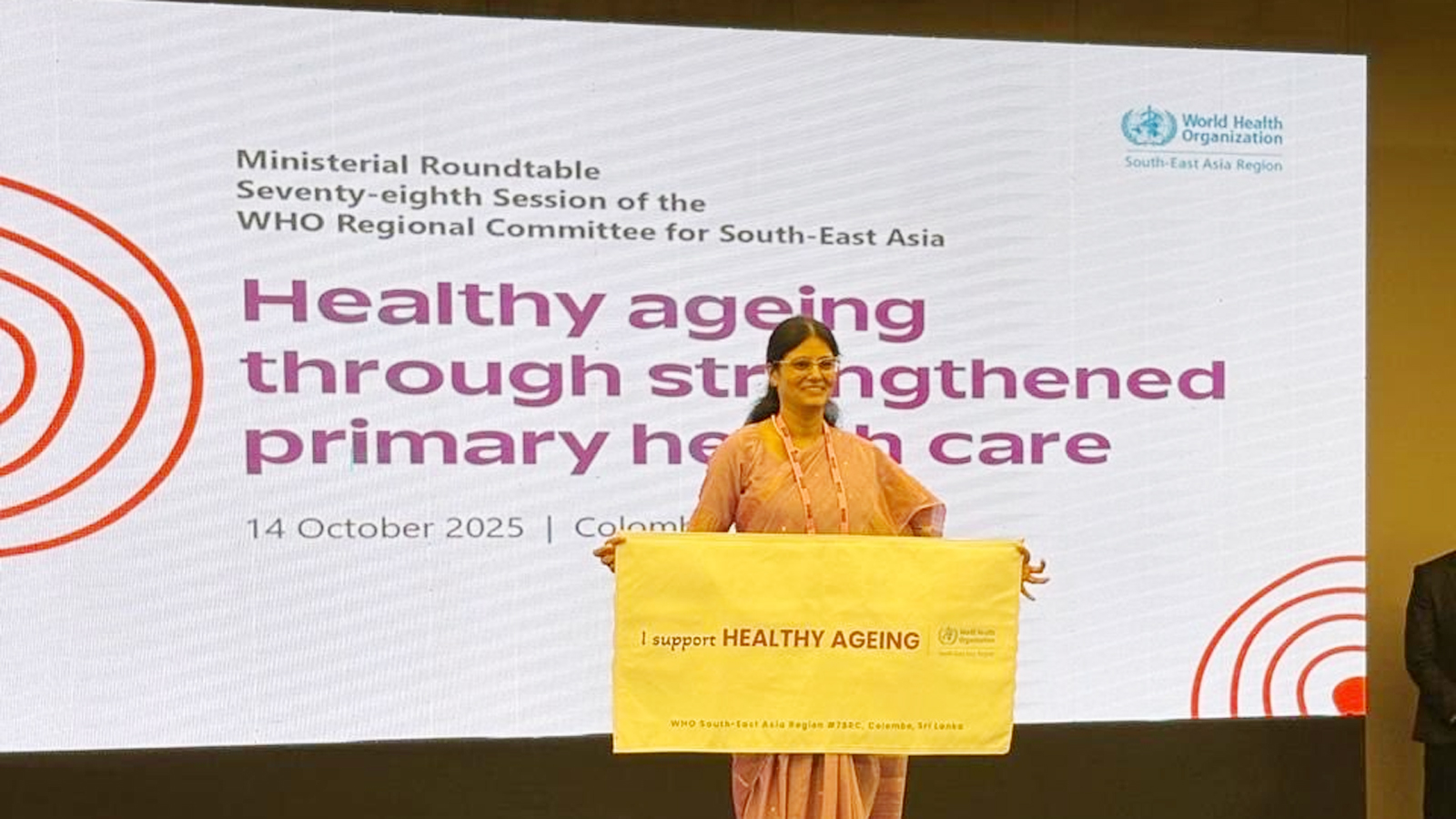
India has reiterated its commitment to promoting healthy ageing and strengthening primary healthcare systems to support the elderly population at the 78th Session of the World Health Organization Regional Committee for South-East Asia, held in Colombo from October 13-15.
Union Minister of State for Health and Family Welfare Anupriya Singh Patel represented India at the ministerial roundtable, where discussions focused on the theme “Healthy Ageing through strengthened primary health care.”
Patel noted that with over 153 million citizens aged 60 and above, India is undergoing a significant demographic transition. She emphasized the government’s commitment to ensuring equitable, affordable, and accessible healthcare tailored to the needs of the elderly through a people-centric approach.
The Union Minister highlighted that the National Programme for Healthcare of the Elderly (NPHCE), now operational in 92% of districts, is central to India’s strategy to provide preventive, promotive, curative, and rehabilitative care for senior citizens. The programme integrates home, community, and facility-based interventions and includes structured caregiver training to support dignified ageing within families and communities.
In a major step toward financial protection, the Ayushman Bharat – Pradhan Mantri Jan Arogya Yojana (AB–PMJAY) has been expanded to include all citizens aged 70 years and above, regardless of income. This initiative will benefit nearly 60 million elderly individuals across 45 million families, offering cashless hospital care of up to ₹5 lakh per family annually in both public and empanelled private hospitals.
Patel also spoke about the establishment of two National Centres of Ageing at All India Institute of Medical Sciences, New Delhi, and Madras Medical College, Chennai, along with 17 regional geriatric centres. These facilities serve as hubs for clinical excellence, research, capacity building, and policy guidance. She further mentioned the ‘Swasth Nari, Sashakt Parivar Abhiyaan’ campaign, under which millions of elderly—particularly women—have been screened for non-communicable diseases such as hypertension, diabetes, and cancers.
At the regional roundtable, India called for greater cooperation among member states to integrate Primary Health Care and Long-Term Care (PHC–LTC) systems. Patel outlined three priority areas for collaboration:
* Establishing a regional platform for knowledge sharing and innovation on PHC–LTC integration.
* Investing in capacity building and training programmes for the geriatric and caregiving workforce.
* Promoting technological innovations that enable independent and dignified living for older adults.
Reaffirming India’s alignment with the UN Decade of Healthy Ageing (2021–2030), Patel stressed the need to view ageing as an opportunity for inclusive growth and social transformation.
“Guided by the vision of the Hon’ble Prime Minister—‘Sabka Saath, Sabka Vikas, Sabka Vishwas, Sabka Prayas’—India remains committed to ensuring that every stage of life, including old age, is lived with dignity, security, and care,” she said.