Researchers in India have developed a cost-effective and high-performance thermal energy storage material that could significantly improve the efficiency of thermal batteries used in concentrated solar power plants and industrial waste heat recovery systems.
The breakthrough has been achieved by scientists at the International Advanced Research Centre for Powder Metallurgy and New Materials (ARCI), an autonomous institution under the Department of Science and Technology (DST).
Thermal energy storage systems play a crucial role in harnessing renewable energy and recovering industrial waste heat. Scientists worldwide have been working to develop materials with higher heat storage capacity, better thermal conductivity and improved operating temperature ranges to enhance the performance of such systems.
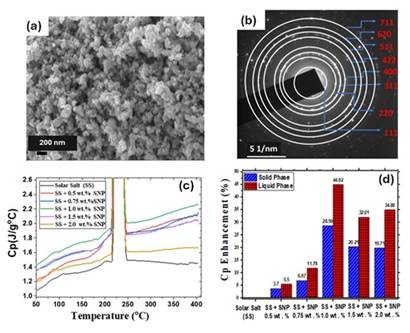
The ARCI research team, led by Dr. Mani Karthik, developed a scalable and economical process to produce spinel nano composite Phase Change Material (PCM) with significantly enhanced thermal storage capability.
The process uses a simple co-precipitation method to produce spinel-type metal oxide nanoparticles with controlled particle size. According to the researchers, these nanoparticles demonstrated excellent thermal stability and uniform dispersion, making them suitable for advanced thermal battery applications.
The study found that adding just 1 per cent spinel oxide nanoparticles to the phase change material increased its specific heat capacity — the ability to store thermal energy — by as much as 45 per cent compared to conventional PCM without nanocomposites.
Researchers explained that the nanoparticles improve the thermal properties of the material by increasing the specific surface area and forming a stable spinel oxide layer at the interface. This enhances surface energy and significantly boosts heat storage capacity.
The enhanced storage efficiency means thermal energy systems can use smaller storage tanks, reducing construction material requirements and lowering both capital and operational costs.
Scientists said the innovation could pave the way for compact, high-performance and affordable thermal energy storage systems for next-generation clean energy applications.
The research has been published in the journal Materials Today Chemistry and aligns with India’s clean energy goals and the vision of Aatma Nirbhar Bharat by strengthening indigenous expertise in advanced energy storage technologies.