
Indian astronomers have detected and measured the properties of an elusive intermediate-mass black hole (IMBH) located in a faint galaxy about 4.3 million light-years away, offering new insights into the mysterious “middleweight” class of black holes.
The discovery was made using India’s largest optical telescope, the 3.6-metre Devasthal Optical Telescope (DOT), operated by the Aryabhatta Research Institute of Observational Sciences (ARIES), an autonomous institute under the Department of Science and Technology (DST). The telescope enabled researchers to trace gas clouds orbiting the black hole at a distance of 125 light-minutes—roughly 2.25 billion kilometres—with a velocity dispersion of 545 kilometres per second.
The black hole, situated in the galaxy NGC 4395, has been found to weigh about 22,000 times the mass of the Sun. This precise measurement makes it one of the best-studied intermediate-mass black holes to date. These IMBHs, with masses between 100 and 100,000 times that of the Sun, are considered vital to understanding how black holes grow and evolve. However, due to their faint emissions and residence in relatively dim galaxies, they have remained difficult to detect.
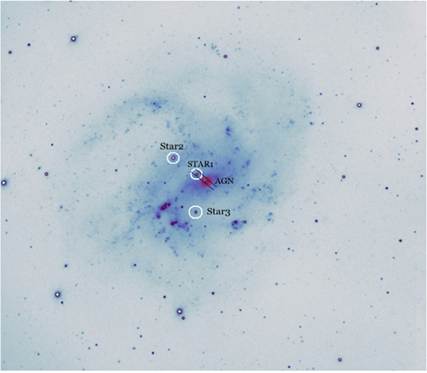
NGC 4395 hosts one of the faintest actively feeding black holes ever observed. To study it, the research team, led by Shivangi Pandey, used not only the 3.6-metre DOT and its indigenously developed spectrograph and camera ADFOSC but also the smaller 1.3-metre Devasthal Fast Optical Telescope (DFOT), also located at ARIES’s Devasthal Observatory.
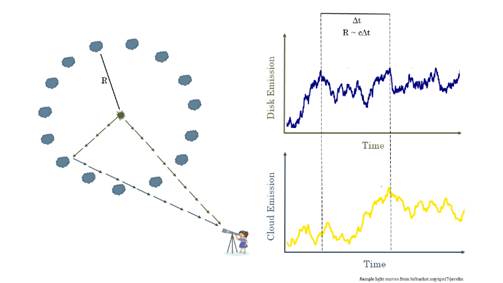
Because the region surrounding a black hole is too small to be directly resolved by most telescopes, the team used a technique known as spectrophotometric reverberation mapping. This method measures the time lag between light emitted from the black hole’s accretion disk and the light echoed by surrounding gas clouds, allowing astronomers to estimate the region’s size and the black hole’s mass.
The study, published in the Astrophysical Journal, also confirms the size-luminosity relationship for black holes in low-luminosity active galaxies and offers a more accurate mass estimate than previous studies. The findings contribute a critical benchmark for future research on black hole growth and evolution.
Dr Suvendu Rakshit, a scientist at ARIES and co-author of the study, said that the search for intermediate-mass black holes is still ongoing. He said that upcoming observations using larger telescopes and more advanced instruments will be essential in identifying and understanding these cosmic objects.