











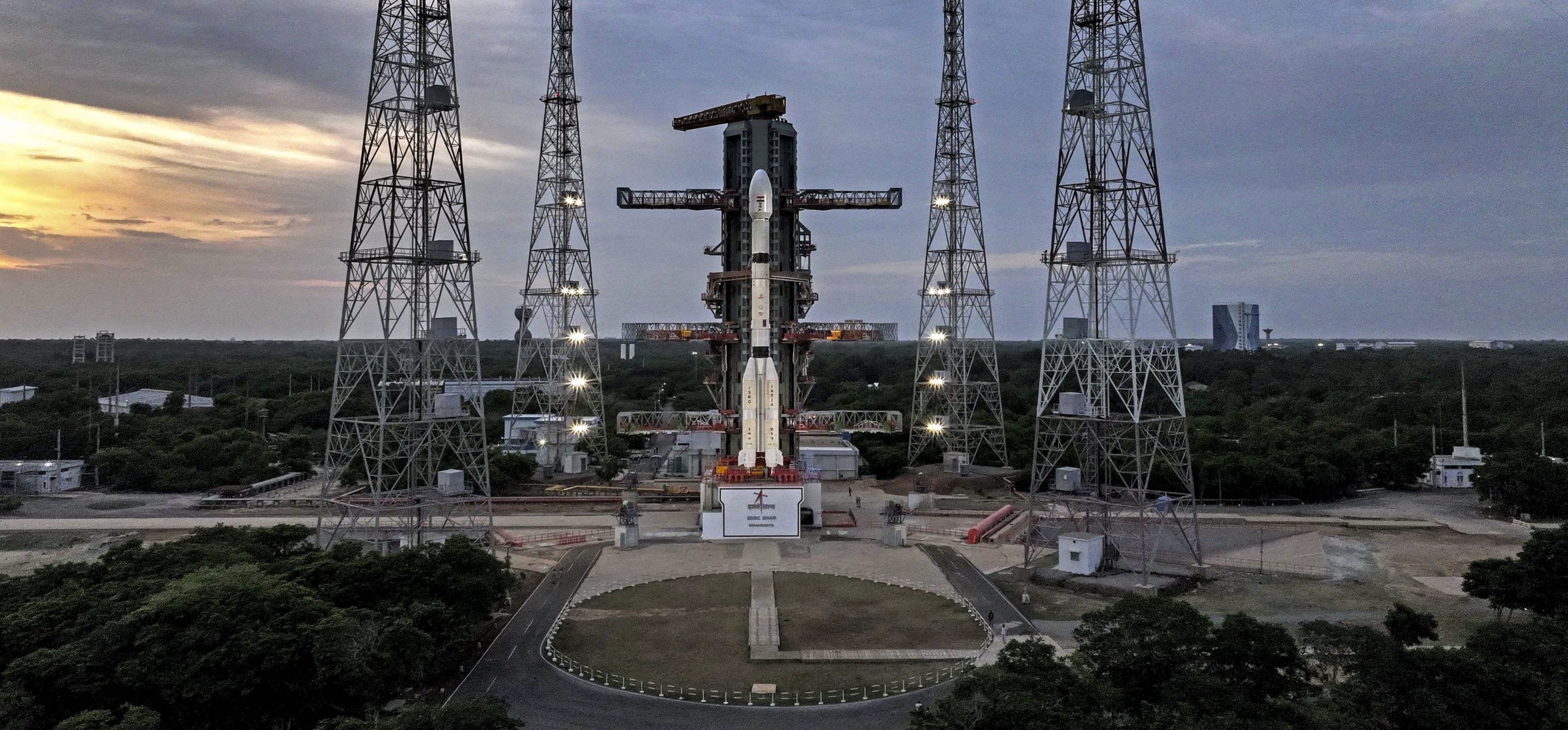
ISRO’s state-of-the art Earth observation spacecraft, the country’s first ever imaging satellite intended for the Geosynchronous orbit, EOS-05 lifted off from the spaceport here on Friday.
Set to provide real-time imagery and help the nation in areas including agriculture, and disaster management, a GSLV-F17 rocket carrying the payload headed into the wide skies carrying the satellite, intended for delivery at the Sub-geosynchronous transfer orbit (Sub-GTO) in the wee hours.
After the completion of a smooth 27-hour countdown, which commenced at 23.30 hours on Wednesday, the rocket, with a 2,367 kg payload mass, began its ascent on dot at 2.55 AM from the second launch pad at Satish Dhawan Space Centre. The odd hour and rain could not deter the enthusiasm of members of public as many turned up to cheer the launch.
While several earth observation satellites operate from low earth orbit (LEO), the EOS-5 satellite is set to hover at an altitude of roughly 36,000 km above earth, which is the geosynchronous orbit and at that level, the satellite will match Earth’s rotational speed.
The GSLV-F-17 is the 19th flight of India’s Geosynchronous Satellite Launch Vehicle.
The 3-stage, 51.7 meter rocket, with its third stage being cryogenic, has a lift off mass of 420.5 tonne and the over-2,000 kg satellite is ensconced on the rocket nose cone.
The GSLV-F17/EOS-05 mission is said to be a replacement for the unsuccessful GSLV-F-10/EOS-03 mission of 2021.
An onboard computer had aborted that mission at 307 seconds into the flight then. A probe into the post-flight data had indicated that an anomaly in the Cryogenic Upper Stage led to the mission failure, according to ISRO.
The pre-dawn launch on Friday follows a gap of nearly 8 months.
On January 12 this year, ISRO’s PSLV-C62 rocket carrying 16 satellites failed to place them in the intended orbit after encountering an “anomaly” in the critical third stage of the launch. This was ISRO’s only launch this year and it failed.
A similar, previous attempt in May 2025 (PSLV-C61-EOS-09) also did not succeed due to a “motor pressure issue,” and there was a fall in the chamber pressure of the motor case.
Days ago, ISRO chairman V Narayanan visited the Tirumala Tirupati Lord Venkateshwara Swamy temple and prayed for the mission’s success.
-PTI







