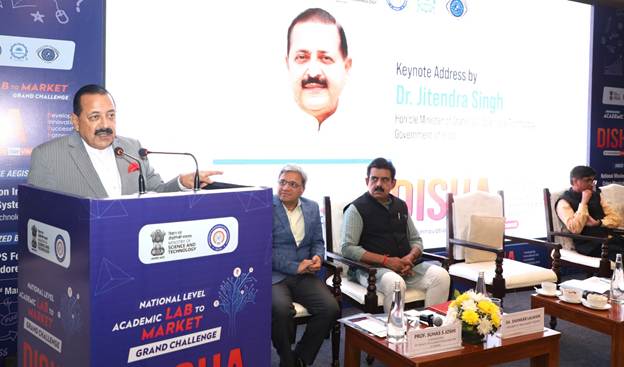


India’s Gross Expenditure on Research and Development (GERD) has more than doubled over the past decade, rising from Rs. 60,196 crore in 2013-14 to Rs. 1.27 lakh crore, according to Union Minister Jitendra Singh. Speaking at the DISHA event at the India Habitat Centre on Monday, the Union Minister of State (Independent Charge) for Science and Technology highlighted the significant growth in India’s R&D investments under Prime Minister Narendra Modi’s leadership. He attributed this increase to the government’s commitment to fostering innovation in key sectors like artificial intelligence, biotechnology, and quantum computing.
“The future economy of India will be shaped by home-grown innovations in deep-tech areas such as AI, biotechnology, and quantum computing,” Singh said. He emphasised that government-backed initiatives have been instrumental in driving scientific advancements and positioning India as a global leader in technological innovation.
Singh also highlighted India’s evolving intellectual property (IP)-driven innovation ecosystem, which is supported by academia, industry, and startups. He credited the government’s push for research and development (R&D) as a key factor in this progress, stressing the importance of transitioning innovations from labs to industries in the pursuit of self-reliance, or ‘Atmanirbhar Bharat.’
Singh lauded the DISHA Program—an initiative aimed at Developing Innovations, Successful Harnessing, and Adoption—as a vital step toward creating a knowledge-based economy. The program supports faculty members and students working on disruptive technologies, ensuring India stays at the forefront of global innovation.
Dr. Jitendra Singh highlighted that initiatives like DISHA support the Anusandhan National Research Foundation (ANRF), which aims to bring together research across science, humanities, and social sciences. This combined effort will help Indian researchers work together across different fields, advancing discovery and application.
One of the key points in Singh’s address was the government’s policy shift to allow private sector participation in strategic fields like space technology and nuclear research. “What was once exclusively handled by government institutions is now open to private enterprises, leading to faster technological advancements, higher efficiency, and increased global competitiveness,” he said.
The minister highlighted the rise of innovation in India’s space sector, where startups are making significant contributions to satellite development, launch services, and space-based applications. He also pointed to the government’s recent decision to involve private companies in the nuclear energy sector, leveraging local expertise to enhance the country’s energy security and sustainability.
Addressing the impact of artificial intelligence in healthcare, Singh spoke about the success of AI-driven mobile telemedicine units in providing healthcare access to remote areas. “AI-powered diagnostics and telemedicine solutions are revolutionising patient care, making high-quality healthcare services more accessible and affordable,” he noted.
However, Singh underscored the importance of balancing AI with human expertise. “AI is here to complement human intelligence, not replace it. A hybrid approach will ensure that technology enhances the role of skilled professionals in critical fields such as healthcare,” he explained.
With India approaching its centenary of independence in 2047, Singh urged the next generation of innovators to lead the country’s technological progress. “The responsibility of building a technologically advanced India lies with our young innovators. What we invest in today will determine our standing in the global economy decades from now,” he said.