







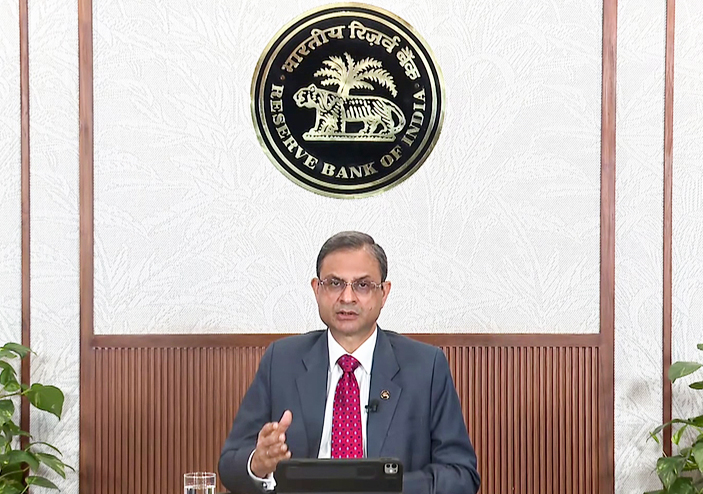
As August inflation print is expected to cross 2% and be closer to 2.3%, a rate cut by the Reserve Bank of India (RBI) in October seems to be a tough move, a research by the State Bank of India (SBI) stated on Wednesday, adding that even a rate cut in December looks slightly difficult if growth numbers for Q1 and Q2 are taken into consideration.
India’s Consumer Price Index (CPI) inflation moderated to 98-month low of 1.55% in July, compared to 2.10% in June and 3.60% in July 2024.
The July data highlights the ninth consecutive month of decline, mainly due to a reduction in food inflation, which is also at 78-month low.
Food inflation declined by 75 basis points (bps) in July, compared to June 2025. The food inflation in July 2025 is the lowest at –1.76%, after January 2019, when it was at –2.24%.
The core inflation also decelerated sharply and, for the first time in the past six months, stood below 4% (at 3.94%). Excluding gold prices, the core inflation decelerated below 3% to 2.96% in July 2025, almost 100 bps lower than the headline core CPI, according to the report. Core Inflation is the change in the costs of goods and services, excluding the price variations in seasonal elements, such as those related to food and energy.
Moreover, India Inc in Q1 FY26, around 2,500 listed entities, reported top-line growth of 5.4% while EBIDTA grew by around 6%.
“In Q2, we may see revenue and margin pressure in export-oriented tariff-affected sectors such as Textile, Gems and Jewellery, Leathers, Chemicals, Agriculture, Auto Components, etc. The overall US CPI inflation (not seasonally adjusted) has also registered a YoY growth of 2.7% in July, which is 40 bps higher than the reading in April, indicating a negative impact of tariffs,” the SBI report mentioned.
Since the RBI MPC decided to cut rates in June and subsequent status quo in August, the 10-year yield has started rising.
From hovering around 6.30% in July, it has now exceeded the 6.45% mark. The bond yield may not become moderate until clarity descends regarding tariffs.
“In this context, we again want to highlight that a yield curve is a public good. In the Indian markets, it is common to find debt market players behaving differently,” the report stated.
For example, if one set of players acts pro-cyclically with the RBI monetary policy stance, the other set of players acts counter-cyclically and sometimes both players act combatively.
“However, after the announcement of the June policy, almost all market participants are selling/behaving in the same manner. This is surprising and results in a skewed price discovery despite headline inflation at an 8-year low,” said the report.
(IANS)