











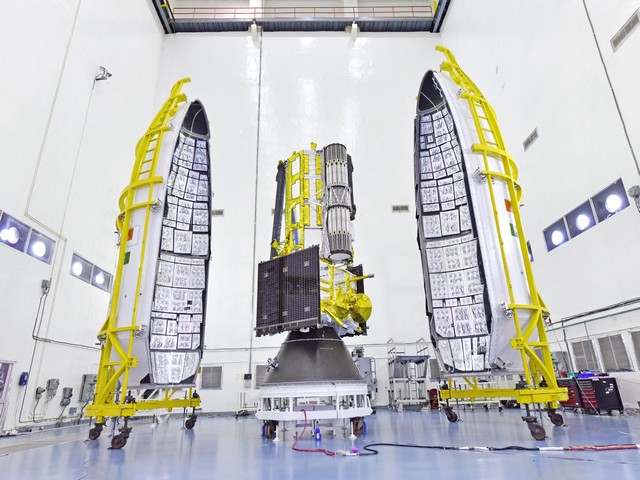
The Indian Space Research Organisation (ISRO) is set to launch the NASA-ISRO Synthetic Aperture Radar (NISAR) satellite today at 17:40 IST from the Satish Dhawan Space Centre in Sriharikota, Andhra Pradesh. This highly anticipated mission marks a major milestone in Indo-US space collaboration, with over a decade of planning and a joint investment of more than USD 1.5 billion.
Developed jointly by ISRO and the American space agency NASA, NISAR is a state-of-the-art Earth observation satellite designed to monitor the planet’s land, ice, and ocean surfaces with unprecedented precision. Weighing 2,392 kg, the satellite will be placed into a Sun Synchronous Polar Orbit—an unusual feat for ISRO’s Geosynchronous Satellite Launch Vehicle (GSLV), which is typically not used for this type of orbit. This launch aboard the GSLV-F16 is the first of its kind for such a mission.
NISAR will complete an orbit around Earth every 97 minutes and will revisit and image the same location every 12 days. The satellite is equipped with a unique dual-band Synthetic Aperture Radar system that operates on both L and S bands. It employs a cutting-edge SweepSAR technique, allowing it to produce high-resolution, wide-swath images across a broad range of terrain.
Union Minister for Science and Technology Dr. Jitendra Singh hailed the mission as more than just a satellite launch, describing it as “India’s scientific handshake with the world.” He said the launch is a defining moment in Indo-US space cooperation and underlines India’s emergence as a global leader in Earth observation technology.
“The satellite will help track subtle shifts in the Earth’s crust and surface movement, contributing to early warnings for natural disasters such as earthquakes, landslides, tsunamis, and volcanic eruptions,” said Singh. “Its applications go beyond disaster monitoring—NISAR will also be instrumental in studying agricultural patterns, soil moisture, ecosystem disturbances, shoreline changes, ship detection, and storm tracking.”
According to ISRO, the first 90 days post-launch will be dedicated to In-Orbit Checkout (IOC), a crucial phase to test and calibrate the satellite before full-scale science operations begin. Once operational, NISAR is expected to serve for at least five years.
Another hallmark of the mission is its open-data policy. All the information collected by NISAR will be freely available to the global scientific community within one to two days of acquisition—and in near real-time in cases of natural disasters or emergencies. This approach is expected to significantly benefit developing nations by providing access to cutting-edge Earth observation data without cost barriers.
(With ANI inputs)







