











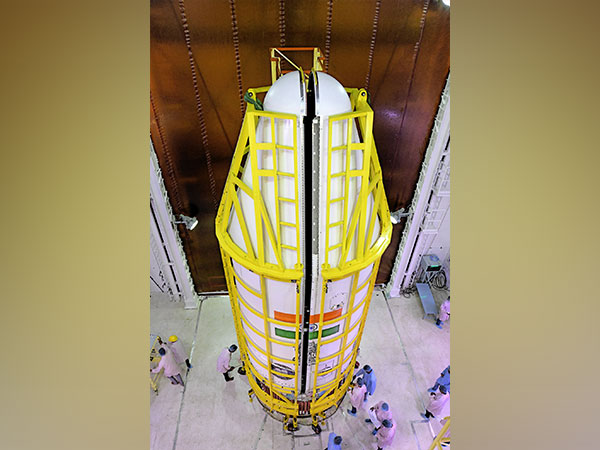
The Indian Space Research Organisation (ISRO) is set to launch its year-end mission, the “Space Docking Experiment” (SpaDeX),on Monday. The mission, aimed at advancing India’s capabilities in orbital docking, will lift off at 10:00:15 PM IST from the Satish Dhawan Space Centre in Sriharikota, Andhra Pradesh.
ISRO confirmed the launch time in a post on X, saying, “Tonight at precisely 10:00:15 PM, PSLV-C60 with SpaDeX and innovative payloads are set for liftoff. SpaDeX is a pioneering mission to establish India’s capability in orbital docking, a key technology for future human spaceflight and satellite servicing missions.”
The SpaDeX mission will be carried aboard the PSLV-C60 rocket, which is designed to deliver two small spacecraft into low-Earth orbit. The primary objective of this mission is to demonstrate crucial technologies for the rendezvous, docking, and undocking of two spacecraft: SDX01, the Chaser, and SDX02, the Target.
This test mission will be conducted in a low-Earth circular orbit, where the spacecraft will perform intricate docking maneuvers, showcasing India’s growing expertise in space technologies.
One of the most challenging aspects of SpaDeX is the precision required for these docking maneuvers, particularly given the small size and mass of the spacecraft compared to previous missions. The mission aims to lay the groundwork for autonomous docking operations in future lunar missions, including the planned Chandrayaan-4 mission, which will operate without Earth-based Global Navigation Satellite System (GNSS) support.
Both spacecraft will carry a differential GNSS-based Satellite Positioning System (SPS) that provides Position, Navigation, and Timing (PNT) solutions. The system will be enhanced by a novel Relative Orbit Determination and Prediction (RODP) processor, which will enable the precise measurement of the relative position and velocity between the Chaser and Target spacecraft. This processor will subtract carrier phase measurements from shared GNSS satellites to determine the highly accurate relative states of both satellites. VHF/UHF (very high frequency/ultra high frequency) transceivers in each spacecraft will further aid this process by transferring GNSS data between the two.
The spacecraft were designed and built by ISRO’s UR Rao Satellite Centre (URSC), with support from other ISRO centers. During the orbital phase, the SpaDeX spacecraft will be controlled from the ISRO Telemetry, Tracking, and Command Network (ISTRAC) using ground stations both from ISRO and external sources.
(With ANI inputs)







