







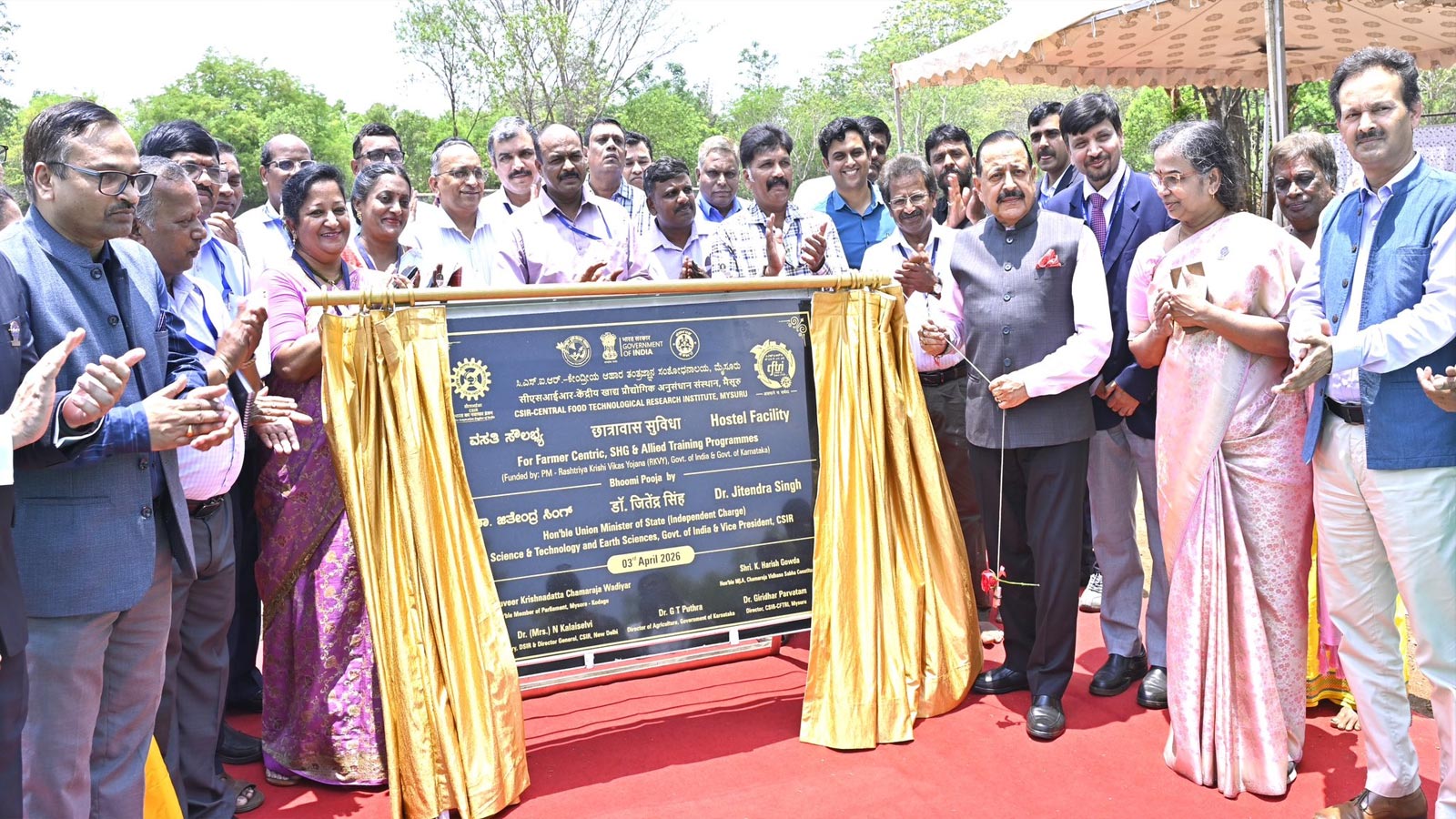


Union Minister Dr. Jitendra Singh on Friday laid the foundation stone for a 30 single-occupancy hostel facility at the Central Food Technology Research Institute (CFTRI) in Mysuru.
The facility, being developed under the Rashtriya Krishi Vikas Yojana (RKVY), is aimed at supporting trainees, farmers, Farmer Producer Organisations (FPOs) and self-help groups through residential training programmes. The upcoming complex at the M.G. Halli campus will accommodate around 50 participants and include kitchen and dining infrastructure. It is expected to be completed within a year.
Boost to Millet Innovation and Training
During his visit, the minister also reviewed India’s first dedicated Centre of Excellence for Millets at CFTRI, describing it as a globally significant initiative linking research with real-world food markets.
He highlighted that millet-based recipes developed using Indian technology are now being served by international food chains such as McDonald’s, reflecting growing global acceptance of traditional Indian grains.
The Centre is also exploring the development of sustainable food products using “Kalari,” a traditional cheese from Jammu and Kashmir, signalling efforts to diversify value-added food innovations.
Advanced Processing Capabilities
The millet centre at CFTRI is equipped with advanced infrastructure, including seven integrated processing lines that enable end-to-end handling of various millets. The facility supports cleaning, dehulling, polishing and sorting, as well as production of value-added products such as flour, semolina, flakes, baked goods and extruded items.
With a processing capacity of up to 1,000 kg per hour and the ability to extend the shelf life of millet flour from one month to nearly ten months, the centre is designed to enhance commercial viability and support startups, farmers and small enterprises.
The Ministry of Science & Technology said the ₹20 crore facility integrates technologies capable of processing all nine varieties of millets, with large-scale capacity and improved nutrient retention in a hygienic, automated environment.
Focus on Entrepreneurship and Market Linkages
Singh emphasised that the next phase of growth lies in expanding the entrepreneurial ecosystem around millet-based products. He called for greater outreach through digital platforms and stronger engagement with startups and MSMEs, particularly in ready-to-eat and convenience food segments.
He stressed that scientific innovation must translate into livelihood opportunities, especially for farmers, women’s groups and small businesses.
Integrated Approach to Food Economy
The minister said the twin initiatives – the millet innovation centre and the new residential training facility – represent a comprehensive approach to food policy by linking research, skill development and enterprise creation.
With increasing global focus on climate-resilient crops and sustainable nutrition, millets are emerging as a key pillar of India’s food strategy. The CFTRI model, combining technology, industry linkages and grassroots capacity-building, is being positioned as a template for driving both economic growth and improved nutritional outcomes.