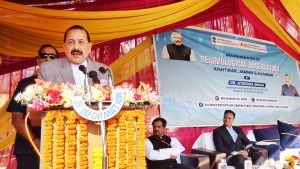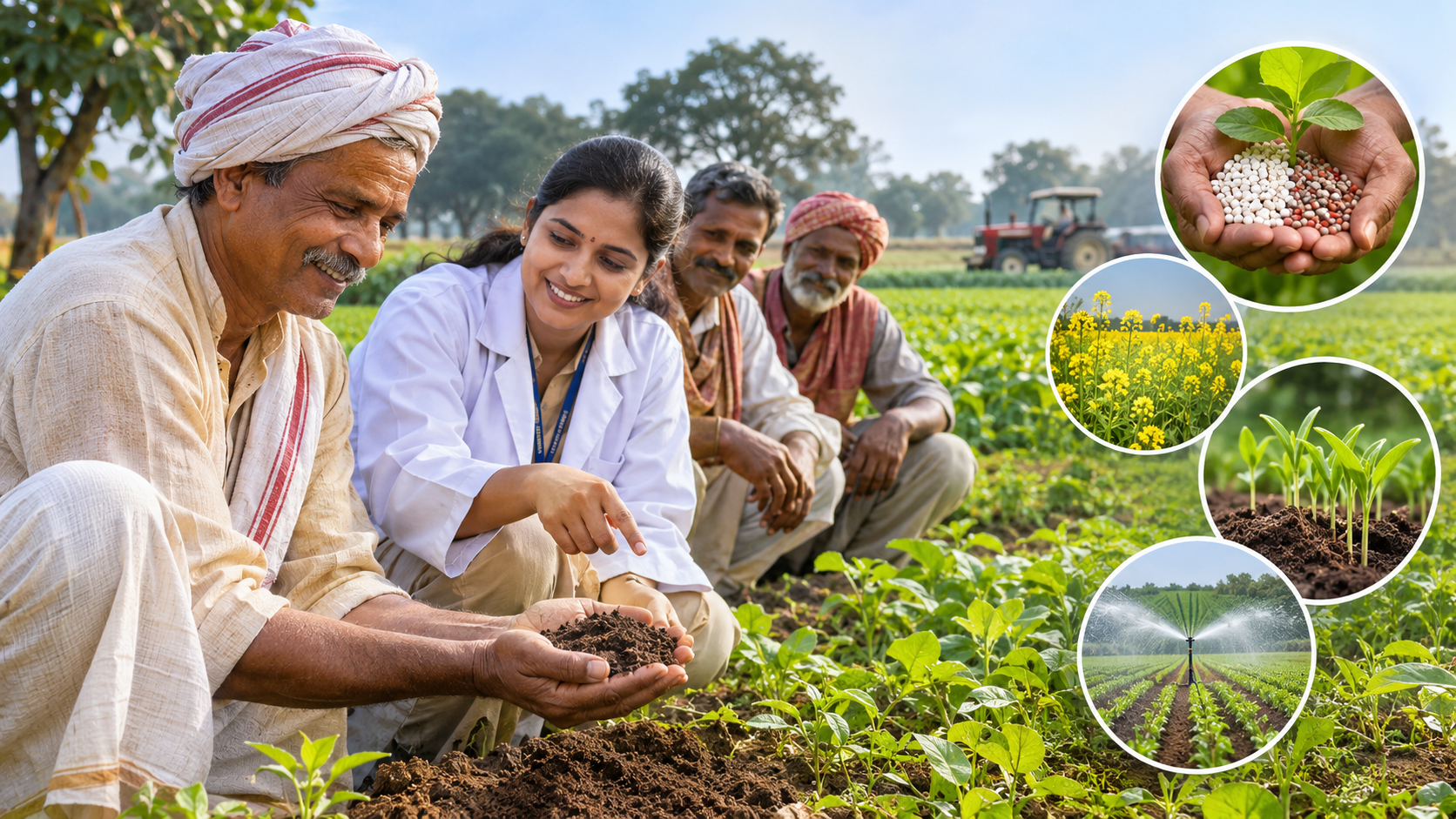
With soil health emerging as a key concern for agricultural productivity and sustainable farming, the Centre has launched the Khet Bachaao Abhiyaan (KBA)-Rabi 2026, a nationwide campaign aimed at promoting balanced fertiliser use, improving soil fertility and encouraging climate-resilient agricultural practices.
Running from October 22 to November 30, 2026, the campaign seeks to reach around 50 lakh farmers across 34 States and Union Territories, more than 700 districts and 50,000 villages. It focuses on addressing challenges such as excessive and imbalanced fertiliser application, declining soil organic matter, rising cultivation costs and degradation of natural resources.
But why has soil health become such an important priority, and how does the campaign plan to bring about changes at the grassroots level?
Why is Soil Health Important for Agriculture?
Soil is one of the most important foundations of agricultural production. Its fertility, nutrient content and ability to retain water directly influence crop growth, productivity and farmers’ incomes.
According to the backgrounder, more than 46 per cent of India’s workforce is engaged in agriculture and allied activities, making soil health an important factor in the country’s food security and rural economy.
However, imbalanced use of chemical fertilisers, declining soil organic carbon and inadequate nutrient management can affect soil fertility over time. These challenges can increase cultivation costs and affect long-term agricultural productivity.
Healthy soil supports better crop growth, improves water retention and helps reduce excessive dependence on external agricultural inputs. This makes sustainable soil management essential for maintaining productivity while conserving natural resources.
What is Khet Bachaao Abhiyaan-Rabi 2026?
Khet Bachaao Abhiyaan-Rabi 2026, with the theme ‘Swasth Dhara, Samriddh Kisan’ (Healthy Soil, Prosperous Farmer), is a nationwide initiative to promote scientific and sustainable agricultural practices.
The campaign follows a convergence-based approach, bringing together State Agriculture Departments, research institutions, agricultural universities, Krishi Vigyan Kendras (KVKs), Agricultural Technology Management Agencies (ATMA) and farming communities.
It aims to encourage farmers to make informed decisions about fertiliser application, adopt natural farming practices, manage crop residues and diversify crops according to local agricultural conditions.
The initiative also focuses on capacity building, farm mechanisation and demonstrations of improved technologies, including regenerative agriculture, which refers to farming practices aimed at restoring soil health and improving biodiversity.
What Are the Major Objectives of the Campaign?
The campaign focuses on several key areas to improve agricultural productivity while ensuring the sustainable use of resources.
1. Balanced Fertiliser Use
One of the major priorities is promoting balanced nutrient management based on General Fertiliser Recommendations (GFR).
It also encourages farmers to follow the 4R principle of fertiliser application:
-
Right Source: Selecting the appropriate fertiliser for the crop and soil.
-
Right Rate: Applying fertilisers in the recommended quantity.
-
Right Time: Applying nutrients at the appropriate stage of crop growth.
-
Right Place: Ensuring nutrients are placed where crops can use them efficiently.
This approach aims to improve nutrient-use efficiency and reduce unnecessary fertiliser application.
2. Promoting Natural Farming
The campaign seeks to encourage natural farming through awareness programmes, demonstrations, training and farmer-to-farmer learning.
It also promotes Integrated Nutrient Management (INM), which involves combining suitable organic, biological and inorganic nutrient sources to maintain soil fertility and meet crop requirements.
3. Crop Residue Management
Crop residue management is another important component, particularly in Punjab, Haryana, Uttar Pradesh and Madhya Pradesh, where the campaign aims to discourage crop residue burning.
Farmers will be encouraged to explore alternatives such as composting, mulching and vermicomposting, which can help recycle agricultural waste and improve soil organic matter.
4. Crop Diversification
The initiative promotes greater cultivation of pulses and oilseeds, along with the productive utilisation of rice-fallow areas.
Crop diversification can help reduce dependence on a limited number of crops and support better utilisation of agricultural resources.
5. Climate-Resilient Agriculture
The campaign also focuses on location-specific agricultural practices in drought-affected areas of Maharashtra, Karnataka, Telangana, Andhra Pradesh and Rajasthan.
Contingency plans will be promoted to help farmers manage climate-related risks and adopt suitable crop and resource management practices.
In addition, awareness will be created about Integrated Pest Management (IPM), pesticide quality and the safe, need-based use of pesticides.
How Can Green Manuring Improve Soil Fertility?
An important aspect of the campaign is the promotion of green manuring, a practice in which specific crops are grown and incorporated into the soil to improve its fertility and organic matter.
A field-level example from East Champaran district of Bihar highlights how this approach can support sustainable agriculture.
During a farmer outreach programme at Pantoka Panchayat in Raxaul block, the ICAR-Mahatma Gandhi Integrated Farming Research Institute (MGIFRI), Motihari, highlighted the benefits of using dhaincha and summer green gram in rice-based cropping systems.
Dhaincha, a green manure crop, can contribute around 50-60 kg of nitrogen per hectare, equivalent to 110-130 kg of urea. Summer green gram can contribute 25-30 kg of nitrogen per hectare, equivalent to 55-65 kg of urea.
These crops help improve soil organic matter and biological activity while potentially reducing the requirement for additional fertilisers.
Farmers were also encouraged to combine farmyard manure, compost, biofertilisers and crop residues with recommended fertiliser doses.
The programme covered rice nursery management and alternatives to crop residue burning. A total of 62 farmers, including 41 women, participated in the initiative and expressed willingness to adopt green manuring and balanced nutrient management.
How Will the Campaign Reach Farmers?
The campaign combines field-level awareness, scientific demonstrations, training programmes and digital communication to extend its reach.
It envisages the deployment of 4,150 teams involving KVKs and ATMA, supported by more than 12,000 scientists and ATMA functionaries.
Some of the major activities include:
-
Awareness programmes: The campaign envisages 5,650 awareness programmes over five weeks, with an estimated outreach of 28.25 lakh farmers.
-
Training sessions: Around 11,750 structured training programmes are planned to strengthen farmers’ knowledge of natural farming, integrated nutrient management, crop residue management and pest control.
-
Field demonstrations: A total of 50,000 demonstrations are envisaged, including 40,000 by KVKs and 10,000 by ICAR institutes. These will showcase improved agricultural technologies and practices.
-
Field and harvest days: Farmers will be encouraged to visit demonstration sites and observe the benefits of improved farming practices under actual field conditions.
-
Digital outreach: Information and advisories will be disseminated through WhatsApp, Facebook, X and other digital platforms. The campaign projects social media outreach of 1.5 crore farmers, with overall digital outreach envisaged to reach 2.5 crore.
The initiative also seeks to strengthen farmer-scientist interactions and encourage peer learning through Farmer Producer Organisations (FPOs), Self-Help Groups (SHGs), Primary Agricultural Credit Societies (PACS) and progressive farmers.
How Will Farmers Benefit from Government Schemes?
Apart from improving farming practices, the campaign aims to connect farmers with government schemes and essential agricultural services.
Awareness activities will cover schemes such as PM-KISAN and the Pradhan Mantri Fasal Bima Yojana (PMFBY), along with Soil Health Cards and the Kisan Credit Card (KCC) scheme.
The initiative will also facilitate the creation and updating of Farmers’ IDs and promote awareness about balanced pesticide use, fertiliser sale regulations and other agricultural support mechanisms.
These interventions are intended to improve farmers’ access to institutional credit, crop insurance and government services, while strengthening the financial security of agricultural households.
What Was Achieved During the Previous Campaign?
The Khet Bachaao Abhiyaan was earlier conducted as a month-long nationwide campaign from June 1 to June 30, 2026.
During this phase, 1,657 multidisciplinary teams were deployed for field-level engagement.
According to the government, the campaign organised more than 1.34 lakh awareness events, reaching 92.44 lakh farmers. It also conducted 6,685 training sessions on green manuring and biofertilisers, benefiting 4.94 lakh farmers.
Additionally, 3,167 field demonstrations and 4,779 interactive programmes were organised. Around 4,916 Janpratinidhi Sammelans were also conducted to strengthen grassroots participation.
Overall, the June campaign directly reached approximately 1.07 crore farmers and other stakeholders, while its social media outreach covered around 4.5 crore citizens.
The Rabi 2026 campaign seeks to build on these efforts through a wider focus on scientific nutrient management, climate resilience and sustainable farming practices.
What Lies Ahead?
The Khet Bachaao Abhiyaan-Rabi 2026 seeks to place soil health and sustainable resource management at the centre of agricultural development.
By bringing together agricultural scientists, government departments, extension networks and farming communities, the campaign aims to translate scientific knowledge into practical, location-specific farming solutions.
Its focus on balanced fertiliser use, natural farming, crop diversification, residue management and integrated pest control is expected to encourage more resource-efficient agricultural practices.
The broader objective is to strengthen soil fertility, improve farm productivity, reduce cultivation costs and support resilient agricultural livelihoods.
The initiative also contributes to India’s broader vision of Viksit Bharat and the Sustainable Development Goals, particularly SDG 2 (Zero Hunger) and SDG 13 (Climate Action).
-PIB