








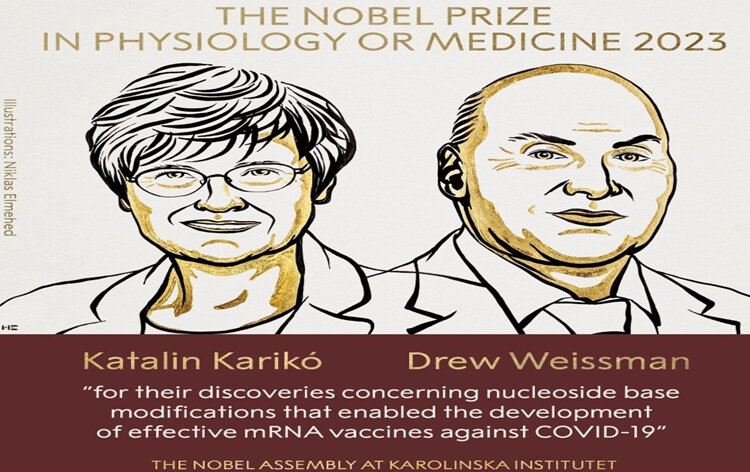
The Nobel Prize in Physiology or Medicine has been announced and it has been awarded to those scientists who developed the mRNA technology that helped in developing mRNA covid vaccines.
Katalin Karikó and Drew Weissman were jointly awarded the prize for advancements that have changed the field of vaccine development. This year’s Nobel Prize in Physiology or Medicine is awarded to a transformative medical technology that significantly altered the path of the pandemic, the mRNA vaccines against COVID.
Previously, For developing the mRNA technologies, Katalin Karik & Drew Weissman along with Pieter Cullis have been awarded the 2022 Tang Prize in Biopharmaceutical Science.
Karikó and Weissman started studying synthetic mRNA technology in the 1990s, when they worked together at the University of Pennsylvania. Their seminal paper in 2005 informed how they were able to successfully deliver modified mRNA into the body and trigger an immune response—the kind that trains the immune system for future viral infections.
Their research opened a new path for possible therapy and vaccine development—one that would prove critical during the COVID pandemic
Messenger RNA (abbreviated mRNA) is a type of single-stranded RNA involved in protein synthesis. mRNA is made from a DNA template during the process of transcription. The role of mRNA is to carry protein information from the DNA in a cell’s nucleus to the cell’s cytoplasm (watery interior), where the protein-making machinery reads the mRNA sequence and translates each three-base codon into its corresponding amino acid in a growing protein chain.
The mRNA COVID vaccines work by injecting the genetic material specifically for SARS-CoV-2’s spike proteins—surface proteins on the virus that allow it to bind to healthy cells. Modified mRNA in the vaccine is taken by cells, which then decode it and produce those spike proteins so that the immune system can better identify and neutralize the real virus in the event of a future infection.
Since the COVID-19 pandemic was declared, vaccines against SARS-CoV-2 were urgently developed around the world. On the basis of the mRNA vaccine technology developed previously, COVID-19 mRNA vaccines were promptly tested in animals, advanced to clinical trials, and then authorized for emergency use in humans.
The development of mRNA vaccine technology, including RNA modification and delivery systems, is well recognized for its contribution to moderating the harms caused by the COVID-19 pandemic.