











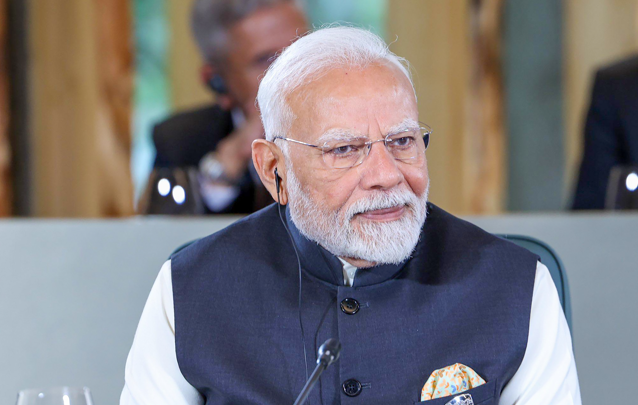
Prime Minister Narendra Modi on Wednesday reaffirmed the Union government’s focus on the welfare and empowerment of workers, emphasising that India’s workforce has remained at the heart of policy, planning, and progress over the past 11 years.
This strategic shift, he said, has driven historic gains in employment generation and significantly expanded the coverage of social protection schemes.
Responding to an article authored by Union Minister Dr. Mansukh Mandaviya, PM Modi wrote on X:
“Union Minister Dr. @mansukhmandviya highlights how over the past 11 years, India’s workforce has been at the centre of policy, planning and progress. This shift has led to historic improvements in employment generation and the expansion of social protection coverage. Do read!”
In his article, titled “11 Years of Empowering Shram Shakti and Building a Future”, Mandaviya elaborated on the Modi government’s efforts to uplift the working population and lay the foundation for a Viksit Bharat (Developed India).
He outlined the government’s multi-pronged approach, which prioritises employment creation, social safety nets, robust institutional mechanisms, and the use of digital infrastructure to reach the last mile.
Mandaviya pointed to flagship initiatives such as Make in India, Skill India, and Digital India, which, when combined with large-scale infrastructure development, have led to substantial job creation.
A notable focus has been placed on empowering women and youth. Citing official data, Mandaviya noted that the female employment rate rose from 22 percent in 2017–18 to 40.3 percent in 2023–24. During the same period, the national unemployment rate declined from 5.6 percent to 3.2 percent.
Youth employability also saw a major boost, climbing from 33 percent in 2013 to 55 percent in 2024. In support of women entrepreneurs, Mandaviya said over 70 centrally sponsored schemes across 15 ministries are currently in operation.
Addressing the unorganised sector, including gig and platform workers, he said the E-Shram portal has been a critical tool in creating a comprehensive database and linking these workers to welfare schemes.
He also outlined the government’s reforms in key social institutions such as the Employees’ Provident Fund Organisation (EPFO) and the Employees’ State Insurance Corporation (ESIC).
Citing data from the International Labour Organization (ILO), Mandaviya noted that India’s social protection coverage rose from 19 percent in 2016 to 64.3 percent in 2025. Over 94 crore citizens are now covered under at least one welfare scheme, making India home to the world’s second-largest welfare system by beneficiary count.







