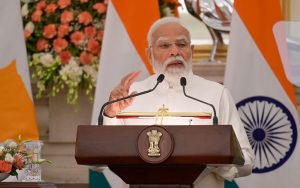
India and Vietnam on Wednesday agreed to expand their bilateral trade to $25 billion by 2030 and further strengthen their strategic ties following wide-ranging talks between Prime Minister Narendra Modi and Vietnamese President To Lam.
The discussions, held at Hyderabad House in New Delhi, covered a broad spectrum of cooperation areas, including defence and security, trade and investment, science and technology, maritime cooperation, renewable and atomic energy, space, and people-to-people exchanges. Regional and global issues of mutual interest also figured prominently in the talks.
During the meeting, PM Modi thanked Vietnam for condemning the recent Pahalgam terror attack and for expressing solidarity with India in its fight against terrorism.
According to the Ministry of External Affairs (MEA), both leaders reaffirmed their commitment to strengthening the India-Vietnam Comprehensive Strategic Partnership and agreed to elevate ties to an “Enhanced Comprehensive Strategic Partnership,” signalling a deeper and more robust engagement.
As part of the outcomes, the two sides set an ambitious target to boost bilateral trade to $25 billion by 2030 and announced Vietnam’s participation in the Indo-Pacific Oceans Initiative, aimed at promoting sustainable maritime cooperation in the region.
India also announced assistance for the establishment of a Site Interpretation Centre at the My Son Temple Complex, a UNESCO World Heritage Site, underscoring cultural collaboration between the two nations.
In a move to enhance agricultural trade, both countries agreed to grant market access for Indian grapes and Vietnamese durians.
The leaders also witnessed the exchange of 13 Memoranda of Understanding (MoUs) spanning key sectors such as rare earth minerals, culture, digital payments, healthcare, tourism, education, academic exchanges, and sister-city cooperation, reflecting the expanding scope of bilateral engagement.
The MEA said the outcomes of the meeting would contribute to strengthening supply chain resilience and enhancing economic cooperation, while reinforcing peace, stability, and prosperity in the Indo-Pacific region.