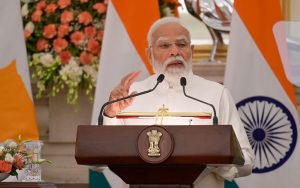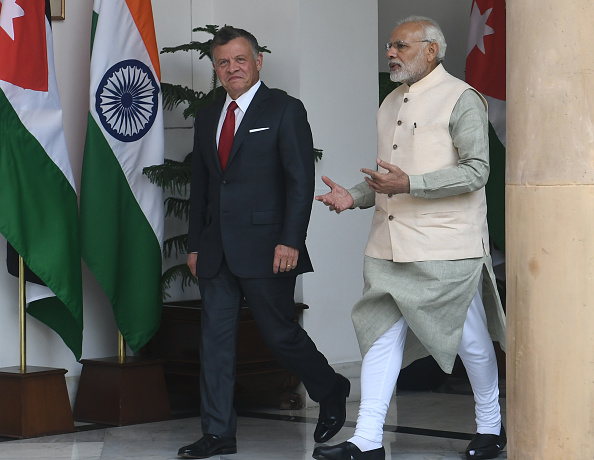
Prime Minister Narendra Modi on Monday held a telephone conversation with King Abdullah II of Jordan, expressing India’s deep concern over the rapidly deteriorating situation in West Asia.
The call came amid escalating military confrontations involving the US, Israel and Iran, which have reportedly drawn in several neighbouring countries through retaliatory strikes and missile attacks.
In a post on X, the Prime Minister said he had spoken with the King of Jordan to convey India’s concern over the evolving regional situation.
He reaffirmed India’s firm support for peace, security and the well-being of the people of Jordan.
The Prime Minister also thanked King Abdullah II for ensuring the safety and care of the Indian community in Jordan during the current crisis.
The outreach reflects India’s diplomatic engagement with regional leaders as tensions intensify in West Asia.
Recent developments include joint US-Israeli strikes on Iranian targets, which, according to reports, resulted in the death of Iran’s Supreme Leader Ayatollah Ali Khamenei.
This was followed by Iranian missile and drone attacks targeting Israel, US military installations and locations in Gulf countries, including Saudi Arabia and Bahrain.
Jordan has reportedly been directly affected, with accounts of intercepted projectiles over its territory causing injuries and property damage.
In response to the evolving security situation, Jordan has implemented partial nightly closures of its airspace as a precautionary measure to safeguard civil aviation, joining other countries that have restricted flights amid heightened risks.
The Prime Minister’s conversation with King Abdullah II follows similar discussions with leaders of Bahrain and Saudi Arabia, during which he condemned attacks on their sovereignty and emphasised India’s solidarity.
These engagements underscore India’s priority of safeguarding its large expatriate workforce in the Middle East while advocating de-escalation and regional stability.
The broader crisis has disrupted international aviation, led to airspace restrictions and heightened concerns of a wider regional conflict, with implications for trade routes, energy supplies and civilian safety.
India has consistently called for dialogue and restraint in international forums, positioning itself as a proponent of peaceful resolution of conflicts.
PM Modi’s message also reaffirmed the strong bilateral ties between India and Jordan, built on mutual respect and cooperation, even as the region faces uncertainty.
Observers say such high-level contacts are aimed at promoting calm and ensuring the welfare of affected populations, including Indian nationals residing across West Asia.
–IANS