Both engines of the Jeju Air 089590.KS plane that crashed last month contained duck remains, according to a preliminary report on Monday, with authorities still trying to determine what caused the deadliest air disaster on South Korean soil.
Although it is rare for such preliminary reports to go beyond factual details, the report gave no indication about what might have led the aircraft to land far down the runway without its landing gear deployed, highlighting the lack of immediate clues after the plane’s black boxes stopped recording four minutes before impact.
The six-page report released by South Korean authorities a month after the crash said both engines of the Boeing BA.N 737-800 jet contained DNA from Baikal Teals, a type of migratory duck that flies to South Korea for winter in huge flocks.
Experts say air accidents are nearly always caused by a cocktail of factors.
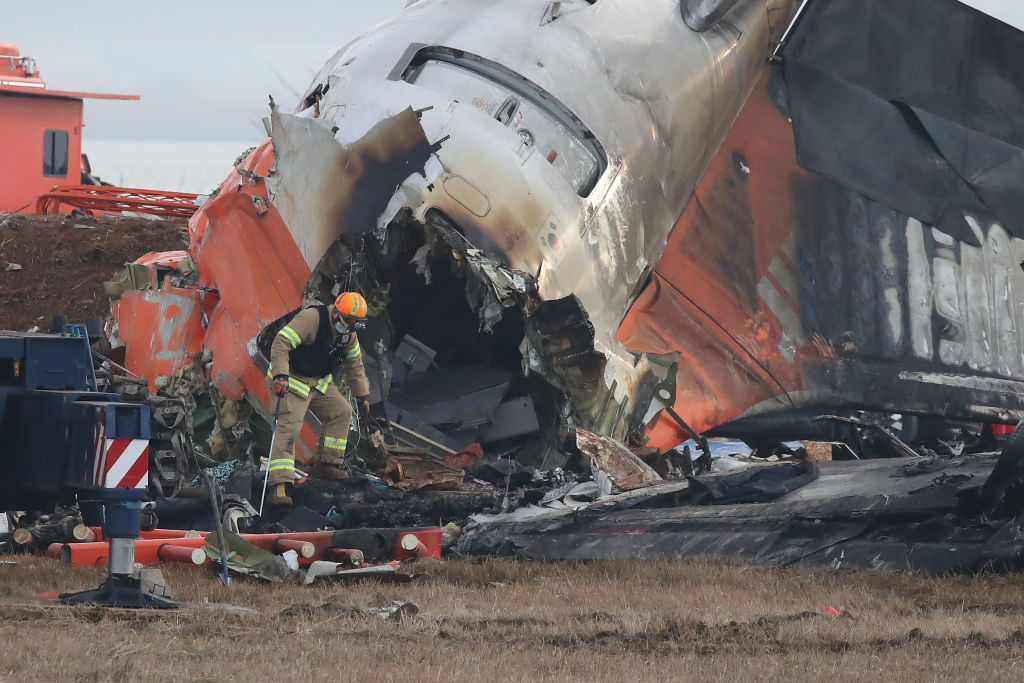
The Jeju Air flight from Bangkok on Dec. 29 overshot Muan Airport’s runway as it made an emergency belly landing and crashed into an embankment containing navigation equipment, called localisers, killing all but two of the 181 people and crew members on board.
“After the crash into the embankment, fire and a partial explosion occurred. Both engines were buried in the embankment’s soil mound, and the fore fuselage scattered up to 30-200 meters from the embankment,” the report said, providing some new pictures of the accident site.
The localiser aids navigation of an aircraft making an approach to the runway, and the structure built of reinforced concrete and earth at Muan airport supporting the system’s antennae likely contributed to the high death toll, experts have said.
The investigation will dismantle the engines, examine components in depth, analyse in-flight and air traffic control data, and investigate the embankment, localisers and evidence of bird strike, the report said about its next steps.
“These all-out investigation activities aim to determine the accurate cause of the accident,” it said.
MAYDAY
The report highlighted much of the initial findings by the South Korean investigators that were shared with victims’ families on Saturday, including the pilots’ awareness of a flock of birds on the plane’s final approach.
The exact time the bird strike was reported by the pilots remains unconfirmed, the accident report said, but the aircraft “made an emergency declaration (Mayday x 3) for a bird strike during a go-around.”
Bird strikes that cause damage to both engines are rare, though there have been successful cases of pilots landing without fatalities in such situations including the “Miracle on the Hudson” river landing in the U.S. in 2009 and a cornfield landing in Russia in 2019.
Investigators usually piece together the final moments before a disaster by carefully synchronising voice and data recordings to understand how the crew and airplane interacted.
But these vital clues are not available for the Jeju Air crash because the recorders stopped recording just before the pilots declared the emergency and about four minutes before impact.
The aircraft was at an altitude of 498 feet (152 metres) flying at 161 knots (298 km/h or 185 mph) about 1.1 nautical miles (2 km or 1.3 miles) from the runway at the moment the flight recorders stopped recording, the report said.
Since 2010 new U.S.-built planes have had to have enough backup power to provide 10 minutes of extra data recording should onboard electrical power fail, following a series of incidents where recorders stopped working.
However, the change came eight months after the 737-800 involved in the Jeju crash appears to have left the Boeing factory, according to data from FlightRadar24.
South Korea’s Aviation and Railway Accident Investigation Board has shared its report with the International Civil Aviation Organization (ICAO), Thailand, and the United States and France, which are the home states for the plane and engine manufacturers, an official said on Monday.
Under global aviation guidelines, investigators issue preliminary reports after 30 days and a final report is expected within a year.
— Reuters