







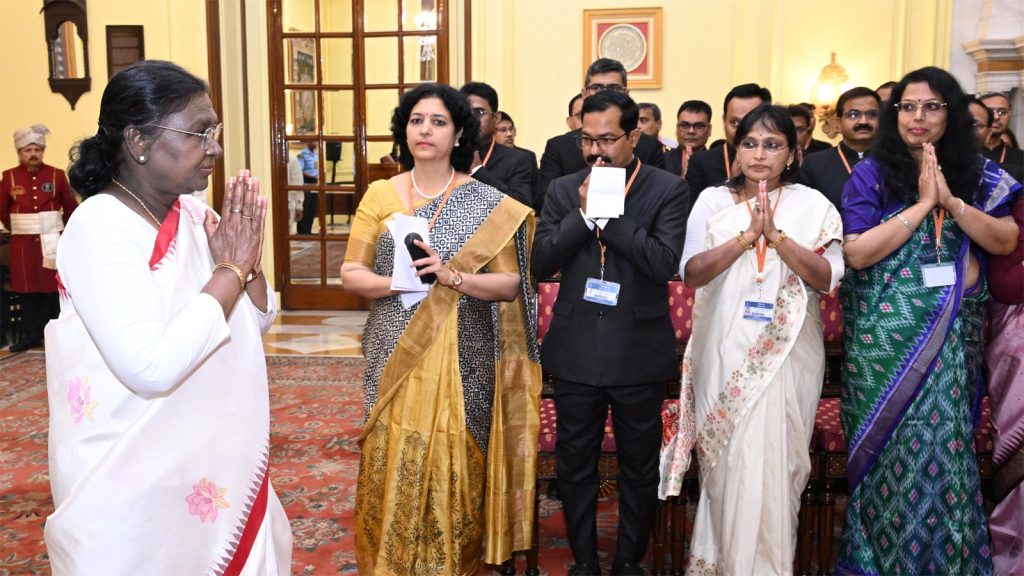


The officers inducted into Indian Administrative Service (IAS) from State Civil Services and currently attending the 128th Induction Training Programme at Lal Bahadur Shastri National Academy of Administration (LBSNAA) called on President Droupadi Murmu at Rashtrapati Bhavan on Monday.
The President described their induction into the IAS as a significant milestone that marks not merely a change in designation but an expansion of responsibility. She said their new role requires a broader national perspective that rises above departmental boundaries and dismantles administrative silos.
“You are no longer administrators of a particular region; you are the custodians of governance standards that must be upheld across the nation,” she said, adding that every decision they take should align with the larger vision of building a “Viksit Bharat” by 2047.
President Murmu emphasised that their collective professionalism, coordination and commitment are vital to strengthening the machinery of governance and driving development outcomes. She expressed confidence that their training at LBSNAA would have broadened their perspectives and equipped them to analyse governance challenges with a holistic approach.
Highlighting their prior experience in state civil services, the President noted that most officers had spent nearly two decades working at the grassroots level, gaining deep insights into local challenges and administrative systems. As IAS officers, she said, they would now be expected to implement policies effectively to fulfil the aspirations of citizens, guided by the spirit of “Nation First.”
The President stressed the importance of inclusive development, stating that India’s transformation into a developed nation would be meaningful only if its benefits reach the most vulnerable and deprived sections. She urged the officers to ensure that no community is left behind due to geographical, social or economic reasons.
She also called on them to prioritise sustainability and climate resilience in governance. “As senior administrators, you must champion green practices, promote climate-adaptive governance, and ensure sustainable development,” she said, noting that present actions would determine the quality of life for future generations.
Underscoring the role of technology in modern governance, President Murmu encouraged the officers to embrace AI-driven solutions, e-governance platforms, digital grievance mechanisms and real-time analytics to enhance service delivery. At the same time, she cautioned that technology must be complemented by human sensitivity and sound judgment.
The President further advised the officers to uphold integrity, transparency and accountability in their duties and to exercise authority with empathy and fairness. She also reminded them to take care of their physical, mental and emotional well-being, given the demanding nature of administrative roles.
Extending her best wishes, President Murmu said the nation looks to them with great hope and expressed confidence that their dedication, wisdom and compassion would help shape a stronger and more inclusive India.