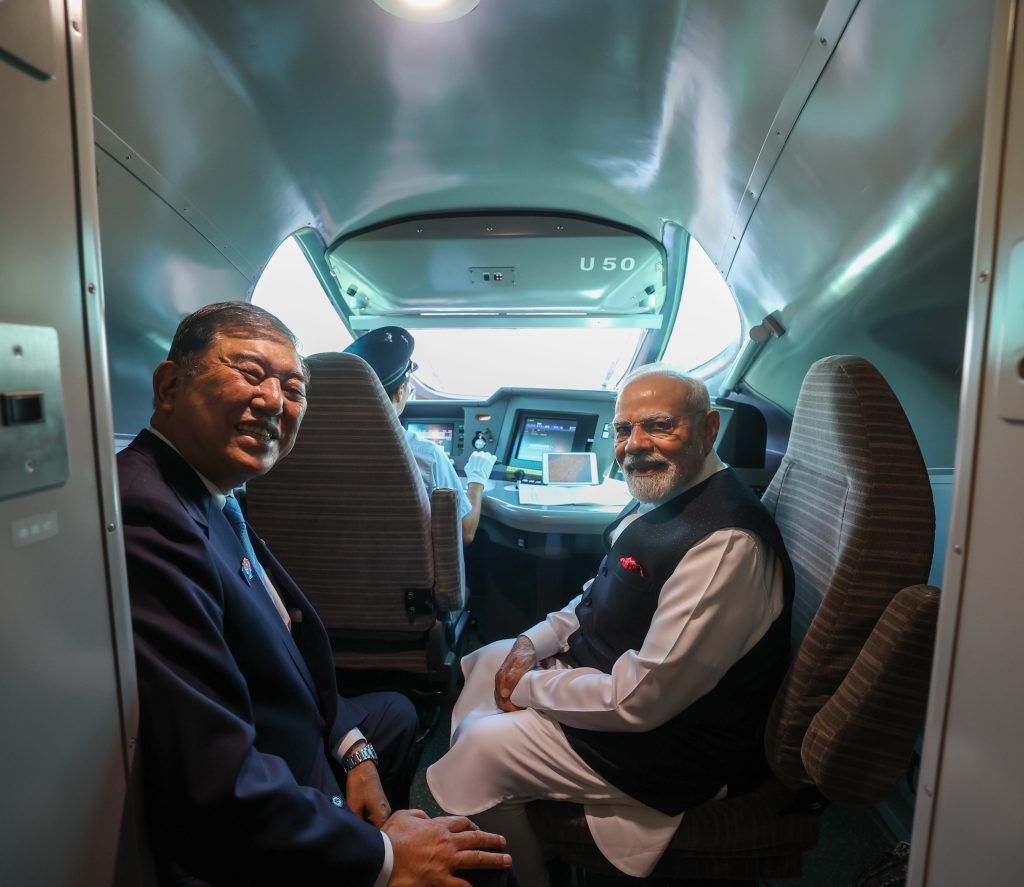
Amid rising uncertainties in India-US trade ties, Prime Minister Narendra Modi’s recent East Asia tour has spotlighted India’s push to deepen regional alliances. His meetings with Japanese Prime Minister Shigeru Ishiba at the 15th India-Japan Annual Summit in Tokyo and Chinese President Xi Jinping at the SCO Summit in Tianjin underscore this strategy. The Tokyo talks zeroed in on a 2035 Vision Statement, prioritising eight areas like economic security, mobility, and green technology. Over a dozen agreements were signed to modernise existing pacts, with Japanese firms committing USD 68 billion in investments and 170 memorandums of understanding with Indian partners. Central to this is Japan’s role in India’s high-speed rail, a game-changer for infrastructure and India-Japan ties.
PM Modi-Ishiba Bullet Train Ride Signals Rapid Ties
A highlight of the Tokyo summit was PM Modi and Ishiba’s ride on Japan’s iconic Shinkansen, symbolising the high-speed rail’s role in fast-tracking bilateral relations. This project aims to slash travel times and strengthen regional connectivity. Both nations agreed to collaborate on producing the advanced E10 Shinkansen in India, featuring earthquake-resistant technology. PM Modi met Indian train drivers training in Japan, a sign of hands-on progress. The Mumbai-Ahmedabad corridor, born from a 2015 agreement and kickstarted in 2017 by Modi and former Japanese PM Shinzo Abe in Sabarmati, Gujarat, remains a flagship of this partnership.
Mumbai-Ahmedabad Corridor Nears Completion
The Mumbai-Ahmedabad High-Speed Rail (MAHSR) is on track, with the Ministry of Railways reporting near-complete station construction. The 508-km line, spanning 348 km in Gujarat, 156 km in Maharashtra, and 4 km in Dadra and Nagar Haveli, will connect 12 stations, including Mumbai’s Bandra-Kurla Complex, Thane, Virar, Boisar, Vapi, Bilimora, Surat, Bharuch, Vadodara, Anand, Ahmedabad, and Sabarmati. The Gujarat section is set to open by 2027, with full operations by 2028, covering the distance in just over two hours. Backed by Japan’s low-interest loans and expertise, ticket prices are yet to be finalised.
South India’s Bullet Train Vision Takes Shape
Andhra Pradesh Chief Minister N Chandrababu Naidu recently announced a survey for a bullet train network linking Hyderabad, Chennai, Amaravati, and Bengaluru. Serving over five crore people, this corridor taps into one of the world’s largest markets. Faster travel will attract businesses, create jobs, and speed up goods transport, boosting factories and farms. This network could lift inter-state trade, adding to India’s economic growth and regional integration.
Nationwide High-Speed Rail Ambitions
The National Rail Plan outlines future high-speed corridors, including Delhi-Varanasi, Delhi-Ahmedabad, Mumbai-Nagpur, Mumbai-Hyderabad, Chennai-Mysore, Delhi-Amritsar, and Varanasi-Howrah. These routes promise to transform India’s economy by connecting major cities. Quicker commutes will expand job access, while faster freight movement will cut costs and strengthen supply chains. Tourism could surge with easier travel, and reduced road traffic may lower accidents and emissions. Such connectivity will drive balanced regional growth, aligning with the vision of Viksit Bharat.
Decoding India’s Bullet Trains
Bullet trains, designed to exceed 250 kmph on dedicated tracks, ensure speed and safety. India’s E10 Shinkansen, inspired by Japan’s cherry blossom aesthetics, boasts earthquake-proof features like L-shaped vehicle guides to prevent derailment and lateral dampers to reduce shaking. With a top speed of 320 kmph, it offers enhanced luggage space, wheelchair-accessible window seats, and flexible seating for passengers or cargo, making it a modern marvel for India’s rail ambitions.
In sum, bullet trains are more than just fast transport; they are a catalyst for infrastructure and connectivity, propelling India towards Viksit Bharat. PM Modi’s East Asia tour, particularly the Japan leg, highlights how India-Japan ties, powered by projects like the Shinkansen, are accelerating the nation’s journey to a stronger, more connected future.