








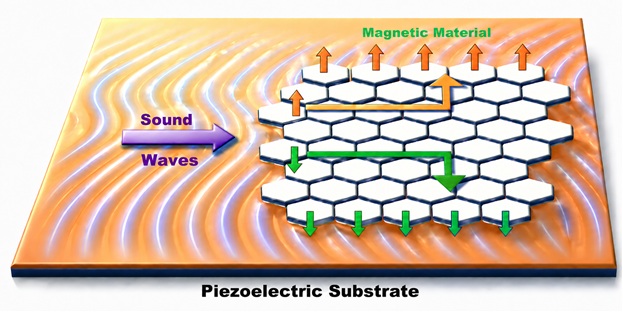
Researchers at the Institute of Nano Science and Technology (INST), Mohali, have developed a theoretical framework that uses sound waves to generate and control spin currents, a finding that could help reduce energy consumption in future computing and communication technologies.
The study, published in Physical Review B, explores a new approach in spintronics — a field that seeks to use the spin of particles, rather than the movement of electric charge, to process and transmit information. Scientists have increasingly been exploring such alternatives as conventional electronic devices generate heat and lose energy through the movement of charge.
The researchers focused on magnons, or waves of magnetic disturbances within materials, which are considered promising carriers of information because they can operate with much lower energy losses than electrons.
Shivam Sharma, a PhD scholar at INST, and his supervisor Prof. Abir De Sarkar developed an analytical model to examine how surface acoustic waves, or sound waves travelling along the surface of a material, affect magnon transport in a two-dimensional magnetic material with a graphene-like structure. To study the phenomenon, they used a graphene-like magnetic material deposited on a piezoelectric substrate, which generates electricity when subjected to mechanical pressure.
According to the researchers, earlier studies had separately shown that surface sound waves can influence electron dynamics and that magnon behaviour can be governed by quantum geometric properties. Their work brings these ideas together through a new theoretical framework.
The study found that when surface acoustic waves travel through the material, they create tiny distortions that act as effective forces, known as pseudogauge fields, influencing the motion of magnons and generating spin currents. The findings provide a new way to generate and control magnon-based spin currents in two-dimensional magnetic materials and could pave the way for low-power information-processing technologies.
According to the Department of Science and Technology, the approach opens up possibilities for highly efficient technologies, including strain-engineered devices in which mechanical deformation is used to control electronic or magnetic behaviour. The findings could be particularly relevant for next-generation computing systems, where reducing energy consumption is a major challenge.
The ministry said the research could also have applications in quantum computing and advanced communication technologies, where energy-efficient methods of information transfer are increasingly being sought.