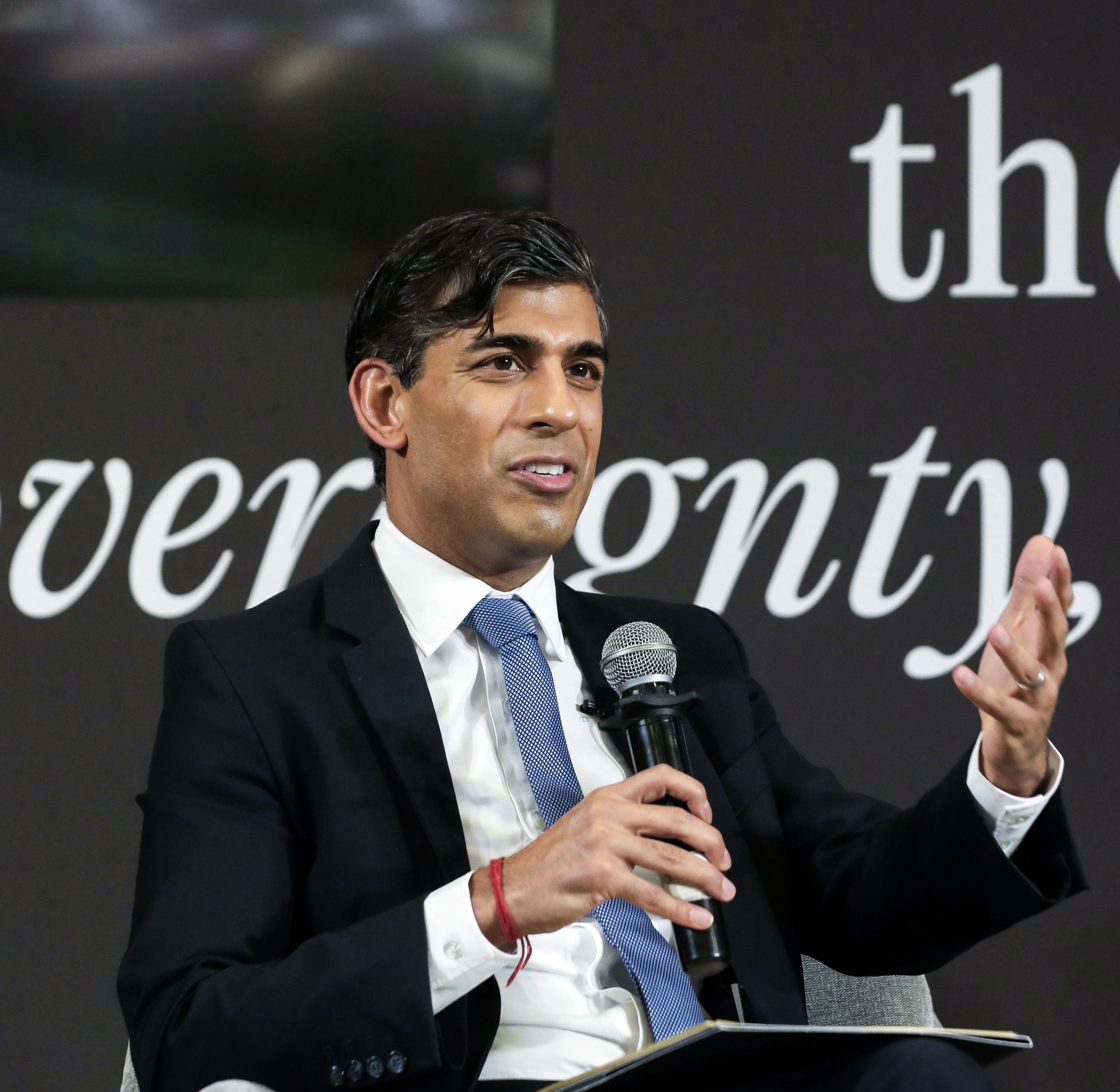
Former UK Prime Minister Rishi Sunak on Thursday lauded India’s unique position in the global AI transformation, crediting its digital public infrastructure for enabling widespread adoption, while Stanford Professor Surya Ganguli outlined three scientific frontiers to advance intelligence far beyond current models, during keynote addresses at the India AI Impact Summit 2026.
Sunak reflected on the rapid acceleration of AI and the responsibility it demands, drawing from the first AI Safety Summit he hosted at Bletchley Park. He stressed the need to balance innovation with safety, noting that “artificial intelligence can do many things, but it will never replace the wonder of human experience.” He contrasted the telephone’s 75-year journey to reach 100 million users with ChatGPT achieving the same milestone in just two months, illustrating the unprecedented pace of change.
Sunak highlighted India’s strengths, pointing to Aadhaar, UPI, health accounts and other digital public infrastructure as the foundations to scale AI for 1.4 billion people. He praised the country’s thriving startup ecosystem, growing unicorn base and innovations such as Sarvam AI, arguing that the “real race” in AI lies in widespread adoption rather than frontier breakthroughs alone. Citing global challenges in food security, healthcare access and education gaps, he said AI offers scalable solutions — empowering farmers, supporting maternal healthcare and delivering personalised learning — to “raise the floor for humanity” and create equality of opportunity.
Surya Ganguli, Professor of AI, Neuroscience and Physics at Stanford University, provided a scientific perspective, highlighting a core paradox: AI systems advance quickly yet remain poorly understood, while the human brain — refined over 500 million years of evolution — vastly outperforms modern AI in data and energy efficiency.
Ganguli identified three key frontiers for advancing intelligence: data efficiency, energy efficiency, and the integration of brains and machines. On data efficiency, he presented recent theoretical breakthroughs explaining neural scaling laws, showing how smarter data selection can transform slow power-law learning into faster exponential gains.
For energy efficiency, Ganguli contrasted the human brain’s 20-watt consumption with AI systems requiring millions of watts. He proposed rethinking the technology stack — from algorithms to quantum hardware — to create “quantum neuromorphic computing” that aligns computation more closely with physical principles.
Most strikingly, Ganguli described brain-machine integration, where digital twins of neural circuits enable decoding perception, simulating disease states and writing precise neural patterns back into the brain. He cited examples from decoding visual perception in mice to controlling epileptic seizures, signalling a future where AI and neuroscience converge to deepen understanding and deliver powerful therapeutic applications.
Together, the addresses presented complementary views: Sunak focused on global governance, equitable adoption and human impact, while Ganguli laid out the scientific pathways needed to surpass today’s limitations. The session reinforced AI as an immediate, transformative force requiring both responsible scaling and fundamental breakthroughs.