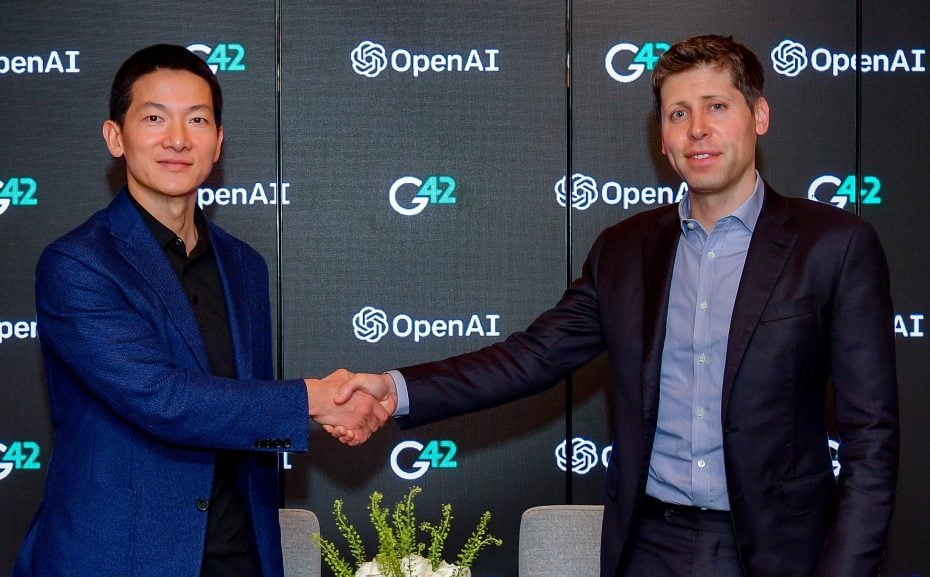
OpenAI CEO Sam Altman and G42 Group CEO Peng Xiao confronted mounting anxieties over artificial intelligence and job displacement at GITEX Global 2025, calling on societies to embrace adaptability and experimentation rather than succumb to fear.
Speaking via live link from San Francisco, Altman challenged the prevailing narrative that technology disrupts while society merely reacts. “In all of my experience, it’s a co-evolving system,” he said. “Technology advances a little, society adjusts, then technology evolves again. It’s not a single shock or reaction, it’s a joint, ongoing process.” He characterized this dynamic as more stable and beneficial for everyone, embodying OpenAI’s philosophy that innovation and social progress develop in tandem.
Reflecting on the extraordinary pace of AI development, Altman remarked, “If people in 2020 had seen what 2025 looks like, they wouldn’t have believed it. Yet here we are, with systems that in some ways operate at an Einstein level, and the world goes on. It’s remarkable and, in many ways, beautiful.”
Peng Xiao struck a similarly pragmatic tone, calling for realism and readiness. “Let’s be grown up and address that,” he said. “If I tell you I have a complete answer, I’d be lying. But in the UAE, we believe the best way to deal with the unknown is to experiment with it.” He emphasized that humans remain central to G42’s operations. “You won’t hear me saying that my office has no humans anymore. We have great employees and partners, but today they are amplified ten to one through AI agents. It is a powerful productivity boost, not a replacement,” he explained.
Peng acknowledged that as systems advance toward potential artificial superintelligence, new risks may emerge. He urged policymakers and leaders to gain hands-on experience rather than remain confined to theoretical discussions. “Rather than addressing this only in think tanks, try AI now in your home, your office, and across society, before we reach superintelligence. Learn, adapt, and manage these risks proactively,” he said.
Both leaders agreed that while the path ahead remains uncertain, the partnership between human ingenuity and machine intelligence presents more opportunity than threat. Their exchange at GITEX highlighted a shared conviction that the future of work will be shaped not by widespread job loss, but by redefinition through experimentation, adaptation, and human creativity.