Scientists have identified the key genetic and developmental mechanisms responsible for seedlessness in grapes, a trait widely preferred by consumers and the global horticulture industry.
The study, conducted by the Agharkar Research Institute (ARI), Pune—an autonomous institute under the Department of Science and Technology—in collaboration with Savitribai Phule Pune University, offers fresh insights into how seedless grapes are formed. The findings have been published in the journal BMC Plant Biology.
Grapes are among the most widely cultivated fruit crops worldwide, with a large portion consumed fresh or processed into products such as raisins and juices. Seedless varieties, known for their thin skin, sweet taste, and better texture, are in particularly high demand.
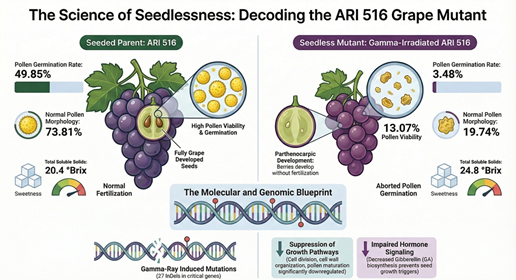
The research focused on a seedless mutant derived from the high-yielding grape variety ARI-516, developed at ARI. A team led by Dr Ravindra Patil carried out a comparative analysis between the seeded variety and its seedless mutant.
Microscopic examination revealed that the seedless mutant showed abnormal pollen structure, very low pollen viability, and an inability of pollen grains to germinate. These factors point to pollen sterility as a key reason behind the absence of seeds.
Further analysis showed that the female reproductive structures in the mutant plants were significantly smaller than those in the seeded variety, disrupting the fertilisation process and resulting in seedless fruit formation.
To understand the molecular basis, researchers conducted transcriptomic analysis using RNA sequencing at different stages of plant development. The results indicated that several genes related to pollen development, cell division, and hormone signalling were less active in the seedless mutant.
Whole-genome sequencing further identified multiple insertion–deletion mutations in genes associated with pollen formation. These genetic variations are believed to impair normal pollen function, leading to seedlessness.
According to the researchers, the findings suggest that the seedless trait arises through parthenocarpy—a process in which fruits develop without fertilisation due to defects in reproductive development.
The study is among the most comprehensive efforts to understand seedlessness in grapes using advanced genomic tools. Scientists say the identification of key genes can help develop molecular markers, enabling faster breeding of improved seedless grape varieties with better yield and quality.