








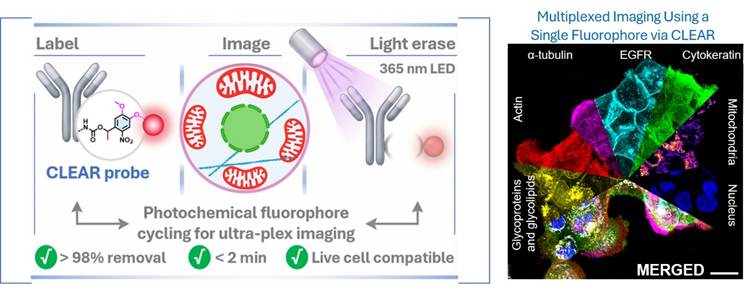
Researchers at the Jawaharlal Nehru Centre for Advanced Scientific Research (JNCASR) have developed a novel imaging platform that could significantly improve the visualization and mapping of proteins within biological samples, potentially aiding research and diagnosis in cancer and neurological disorders.
The technology, called Cleavable Light-Erased Antibody Reporter (CLEAR), enables scientists to visualize a large number of proteins within the same biological sample using a single fluorescent marker, overcoming a major challenge in spatial protein mapping.
Proteins play a critical role in biological functions and disease detection, but accurately mapping multiple proteins within tissues and cells while preserving their spatial organisation has remained difficult using conventional imaging methods.
According to the Ministry of Science and Technology, the CLEAR platform could enable high-resolution and high-plex imaging across cells and tissues, opening new possibilities in cancer biology, immunology and neurobiological research.
The research team was led by Sarit S. Agasti, which designed and synthesised the CLEAR probes, developed the imaging workflow and validated the platform across different biological systems. Researchers from the Indian Institute of Science also collaborated in demonstrating the technology in complex biological settings, particularly immune cell systems.
The scientists introduced a light-cleavable probe system that allows repeated cycles of protein labelling and imaging within the same spectral window. After imaging a set of proteins, the fluorescent signal can be erased using a gentle pulse of 365 nm LED light, enabling researchers to label and image a new set of proteins in the same cell.
The process, described by researchers as functioning like a chalkboard that can be erased and rewritten repeatedly, allows increasingly detailed protein maps to be generated across specimens ranging from single cells to complex tissue sections.
Unlike existing multiplex imaging methods, CLEAR combines high multiplexing capability with speed, spatial resolution and compatibility with delicate biological samples, including live cells.
The Ministry said the technology has the potential to improve early disease detection, particularly in cancers and neurological disorders, while also helping researchers better understand immune responses and cellular behaviour.
In the long term, the platform could contribute to precision medicine by enabling detailed molecular analysis that can support targeted therapies and personalised treatment approaches.
The findings of the study have been published in the journal Royal Society of Chemistry’s Chemical Science.