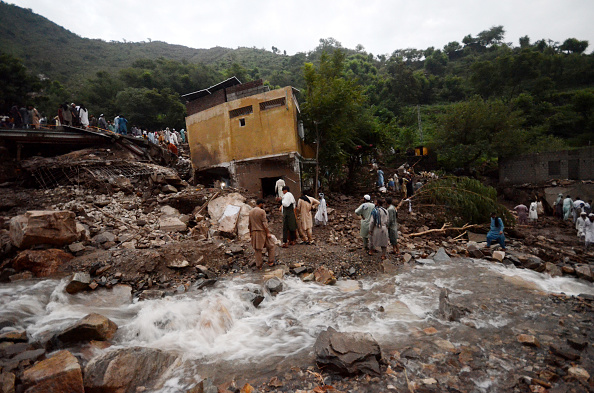
Massive, sudden downpours of rain known as cloudbursts have struck Pakistan and India during this monsoon season, killing hundreds of people in the flash floods and landslides they have triggered.
WHAT ARE CLOUDBURSTS AND WHY DO THEY OCCUR?
By a widely accepted definition, a cloudburst means more than 100 mm (4 inches) of rainfall in one hour, over a small area.
This year, the monsoon, which originates in the Bay of Bengal and then sweeps westwards across northern India to Pakistan every summer, has brought deadly cloudbursts.
Weather studies say cloudbursts typically occur in South Asia when warm, monsoon winds, laden with moisture, meet the cold mountain air in the north of India and Pakistan, causing condensation. With a warming planet, the monsoon has hotter air, which can carry more moisture.
India’s weather department data shows cloudbursts are most common in the Himalayan regions of Jammu & Kashmir, Ladakh, Himachal Pradesh and Uttarakhand.
Fahad Saeed, a senior climate scientist at Berlin-based Climate Analytics, said that in the mountains of northern Pakistan, the warm monsoon system coming from the east was meeting colder air coming from the west, from the subtropical jet stream – a high-altitude weather system that originates in the Mediterranean.
Global warming is pushing this jet stream further south in summer, he said, where it can now combine with the lower-level clouds of the monsoon in Pakistan, forming a tower of clouds which then generatesg intense rain.
Similar intense rainfall, though triggered by different local factors, takes place around the world, such as the floods in Texas in July, when more than 300 mm of rain fell in less than an hour, sending a wall of water down the Guadalupe River.
WHY IS THE REGION BEING HIT SO BADLY BY CLOUDBURSTS?
This monsoon season has so far seen at least four major deadly cloudbursts, including in Uttarakhand, India, where video captured the moment when village buildings were swept down a mountain, and in Buner, in the Hindu Kush mountain range in Pakistan, where more than 200 people died after at least 150 mm of rain fell within an hour.
S D Sanap, a scientist with the India Meteorological Department’s Pune office, said such cloudburst events were becoming more frequent in the western Himalayas, which run across India and into Pakistan, but pinning the rise on a single cause was not easy.
The cloudburst events on both sides of the border were triggered the same way: very moist monsoon air, upslope winds, and storms that stalled over valleys, said Moetasim Ashfaq, a weather expert based in the U.S.
If a cloudburst happens over flat land, the rainfall spreads over a wide area, so the impact is less severe, said Pradeep Dangol, a senior hydrology research associate at the International Centre for Integrated Mountain Development, based in Nepal.
But in steep mountain valleys, the rain is concentrated into narrow streams and slopes, with the potential to trigger flash floods and landslides, he said.
CAN CLOUDBURSTS BE PREDICTED?
Forecasting such events days in advance is nearly impossible, though radars can track the build-up of dense cloud formations and give short-term warnings of intense downpours, Sanap said.
To strengthen monitoring, the India Meteorological Department has installed new radars across the Himalayas and set up observatories aimed at improving early warnings and understanding of these extreme weather events.
Syed Muhammad Tayyab Shah, who leads risk assessment at Pakistan’s National Disaster Management Authority, part of the government, said that it was possible to warn about the general area but not possible to pinpoint the exact location in advance where a cloudburst will happen.
(Reuters)