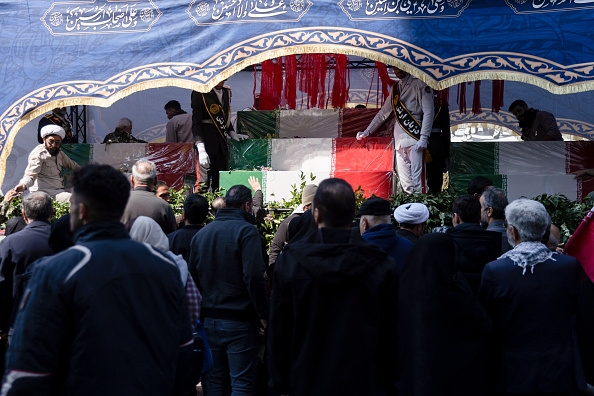
Iran’s veteran supreme leader and a host of other top figures and Revolutionary Guards commanders have been killed in U.S.-Israeli strikes but the ruling system has maintained its ability to strategise and operate in the war that began on February 28.
Born from a 1979 revolution, the Islamic Republic built a complex power structure with layered institutions buttressed by a shared commitment to the survival of the theocratic system rather than relying on a small number of individuals.
IS THE SUPREME LEADER REALLY IN CHARGE?
Iran’s veteran Supreme Leader Ayatollah Ali Khamenei was killed in one of the first strikes of the war. In office since 1989 he enjoyed unquestioning obedience throughout the system and the last say on all major issues.
Under Iran’s official ideology of velayat-e faqih, or ‘rule of the Islamic jurist’, the supreme leader is a learned cleric wielding temporal power on behalf of Shi’ite Islam’s 12th imam, who disappeared in the ninth century.
The leader’s office, known as the bayt, has a large staff that shadows other parts of Iran’s government, allowing the leader to intervene directly across the bureaucracy.
The new leader, Khamenei’s son Mojtaba, has inherited the role and its extensive formal powers, but he lacks the automatic authority enjoyed by his father. The choice of the Revolutionary Guards, he may also be beholden to the hardline military corps.
He was wounded in the strikes, and has been referred to on state TV as a “janbaz”, or “wounded veteran” of the current conflict. More than three weeks after his appointment he has not been seen in any photograph or video clip by Iranians and has only issued two written statements, raising questions over his condition.
HOW CENTRAL IS THE ISLAMIC REVOLUTIONARY GUARDS CORPS?
The Guards have been growing in influence for decades, but in the midst of a war and after the killing of Ali Khamenei and installation of Mojtaba Khamenei, they have assumed an even more central role in strategic decision-making.
Long prepared to withstand decapitation of their leadership, the Guards have a “mosaic” organisational structure with a line of replacements already named for each commander, and every unit able to operate independently according to set plans.
Many top-ranking Guards commanders were killed early on – following a long list of senior commanders killed in strikes last year – but they have been replaced with other experienced men who have so far proven able to manage a complex war effort.
That resilience reflects the command depth of a corps that took the lead in the devastating 1980-88 war with Iraq and has spearheaded Iran’s close involvement with groups fighting in a host of other conflicts around the Middle East for decades.
WHAT ROLE DOES THE POLITICAL LEADERSHIP PLAY?
Iran’s political system merges clerical rule with an elected president and parliament, and they all have a significant role in running the Islamic Republic along with the Guards.
The killing of the late Khamenei’s main adviser Ali Larijani was a real blow to the ruling authorities given his extensive experience, his ability to operate between Iran’s different power centres and his skills negotiating with the outside world.
Other capable, experienced political figures remain but the more prominent ones likely to step into the shoes of Larijani and other assassinated individuals may be more hardline than those who have been killed.
WHO ARE SOME OF THE BIG NAMES LEFT?
Revolutionary Guards head Ahmad Vahidi: the corps’ latest commander was appointed after his two immediate predecessors were killed. Influential in the Guards for years, he fought in the Iran-Iraq war, ran the Qods Force, served as defence minister and helped crush internal dissent.
Revolutionary Guards’ Qods Force chief Esmail Qaani: A secretive figure, he has managed Iran’s ties with proxies and allies across the region since taking over the unit in 2020 when its veteran leader Qassem Soleimani was killed by a U.S. drone.
Revolutionary Guards naval head Alireza Tangsiri: An experienced commander in place since 2018, Tangsiri has played a significant part in Iran’s closure of the Strait of Hormuz.
Parliament Speaker Mohammad Baqer Qalibaf: a former Revolutionary Guards commander, Tehran mayor and failed presidential candidate, Qalibaf may be the biggest political heavyweight still alive.
He has been increasingly vocal over recent weeks, setting out Iran’s stance as the war has developed and was said by an Israeli official and a source familiar with the matter to have been negotiating with the U.S. over recent days.
Judiciary Head Ayatollah Gholamhossein Mohseni-Ejei: a former intelligence head sanctioned for his role in the deadly repression of mass protests in 2009, Mohseni-Ejei is widely seen as a hardliner.
President Masoud Pezeshkian: While Iran’s presidency is far less important than it once was, Pezeshkian is the most senior directly elected figure in Iran, giving him an important voice. The limits of his influence were starkly illustrated earlier this month when he incurred the Guards ire by apologising to Gulf states for Iranian attacks on their territory and he had to partially retract his comments.
Former Supreme National Security chief Saeed Jalili: An injured veteran of the Iran-Iraq war and one of the most hardline figures in Iranian politics, he was the losing 2024 presidential candidate and uncompromising former nuclear negotiator.
Guardian Council member Ayatollah Alireza Arafi: The senior cleric is a leading member of the Guardian Council, the body that chooses which candidates to exclude from elections, and was so well trusted that he was chosen to join the three-man interim council running Iran after Khamenei’s death.
Foreign Minister Abbas Araqchi: The veteran diplomat has conducted high-stakes negotiations with Iran’s Western foes for years, as well as with global powers Russia and China, which have a better relationship with Tehran, and with Iran’s Arab neighbours and rivals
(REUTERS)