











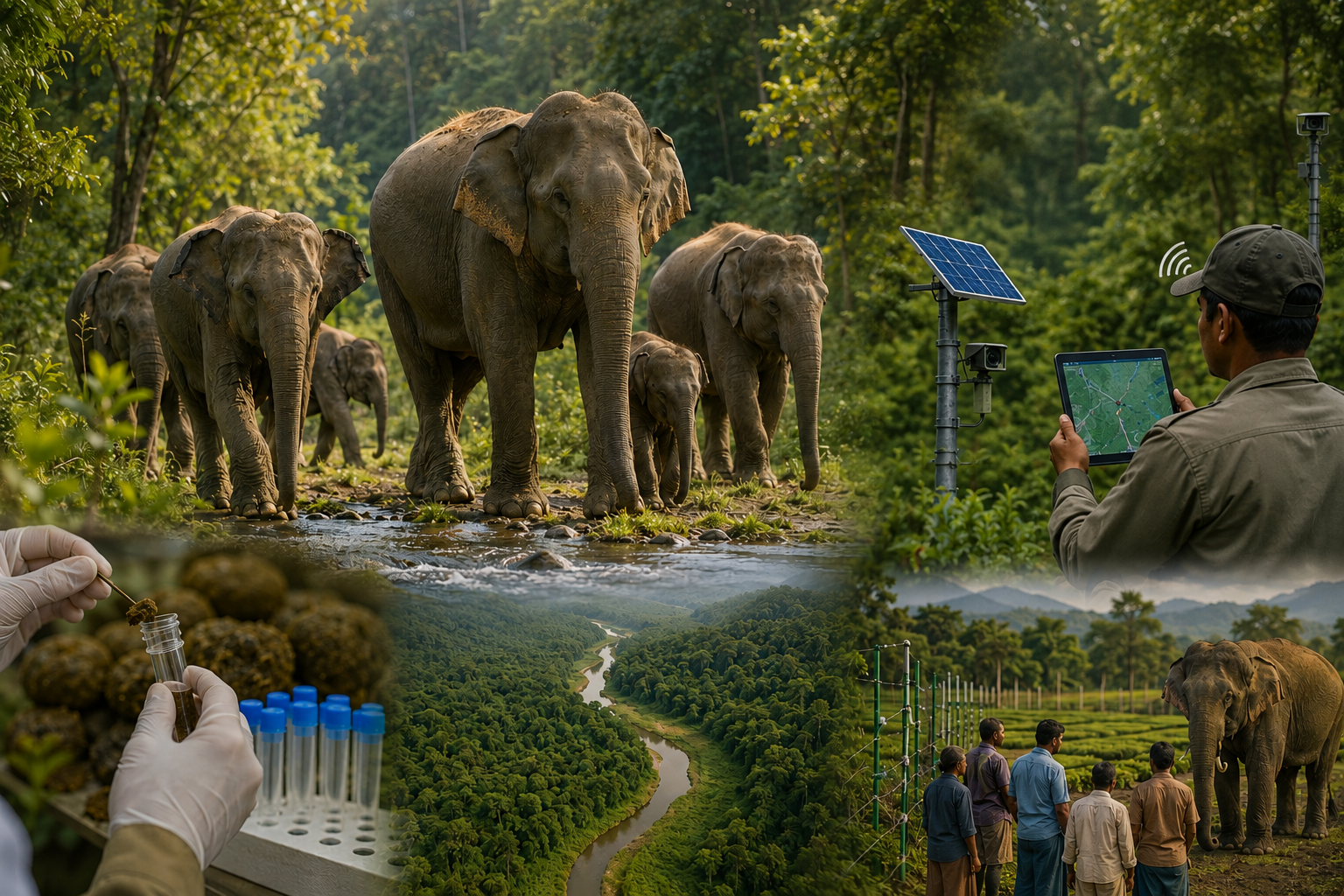
India is strengthening its efforts to conserve elephants through protected habitats, ecological corridors, scientific monitoring and community participation as the country observes World Elephant Day 2026.
India is home to nearly 60 per cent of the world’s wild Asian elephant population. The Synchronous All India Population Estimation of Elephants (SAIEE) 2021–25 has estimated the country’s wild elephant population at 22,446. These elephants are protected across 33 Elephant Reserves and 150 identified corridors.
Elephants play a key role in maintaining forest ecosystems. Their movement creates pathways and water holes that benefit other wildlife, while their feeding habits contribute to nutrient cycling and seed dispersal, supporting forest regeneration and biodiversity.
The Government’s flagship Project Elephant, implemented by the Ministry of Environment, Forest and Climate Change, provides financial and technical support to states for protecting elephant habitats, conserving captive elephants and mitigating human-elephant conflict. The programme also promotes technology-based conservation measures, including AI-enabled monitoring, radio-collaring, genetic databases and early warning systems.
The latest elephant population assessment used India’s first DNA-based synchronised elephant census. Scientists analysed dung samples to identify individual elephants through genetic fingerprints. The assessment combined DNA profiling with block counts and line-transect surveys to strengthen the scientific basis of population estimates.
Elephant corridors remain an important part of the conservation strategy as they connect fragmented habitats and facilitate safe movement of elephant populations. According to Elephant Corridors of India, 2023, there are 150 identified corridors across four regions, including 52 in the East-Central region, 48 in the North-East, 32 in the Southern region and 18 in the Northern region.
West Bengal has the highest number of corridors at 26. The network also includes 19 inter-state corridors and six transboundary corridors connecting India and Nepal.
The network of Elephant Reserves has also expanded since 2014 and now covers 80,777 square kilometres across 14 major elephant-range states, bringing an additional 8,610 square kilometres under protection.
The government has also taken measures to reduce elephant deaths on railway tracks. Surveys covered 127 sensitive railway stretches spanning 3,452.4 kilometres, with 77 stretches across 14 states recommended for mitigation measures. These include underpasses, overpasses, ramps, level crossings and bridge modifications, supported by technologies such as optical-fibre-based intrusion detection, seismic sensors and thermal cameras.
AI-enabled Distributed Acoustic Sensing systems provide real-time alerts to loco pilots, station masters and control rooms. According to the government, train-hit elephant deaths declined from 26 in 2013 to 12 in 2024.
Conservation efforts also extend to captive elephants. The Gajah Suchana mobile application maintains a national genetic database containing DNA profiles, morphological characteristics and ownership details of registered captive elephants. The government has also notified the Captive Elephant (Transfer or Transport) Rules, 2024 to regulate their movement and strengthen safeguards against illegal transfers.
Recognising the importance of community participation, the government provides ex-gratia assistance in cases of human-wildlife conflict. Support includes compensation for death or permanent incapacitation, grievous and minor injuries, as well as crop and property losses according to State and Union Territory norms. Human-Wildlife Conflict Advisory and elephant-specific conflict mitigation guidelines issued in 2023 have further strengthened measures for peaceful coexistence.







