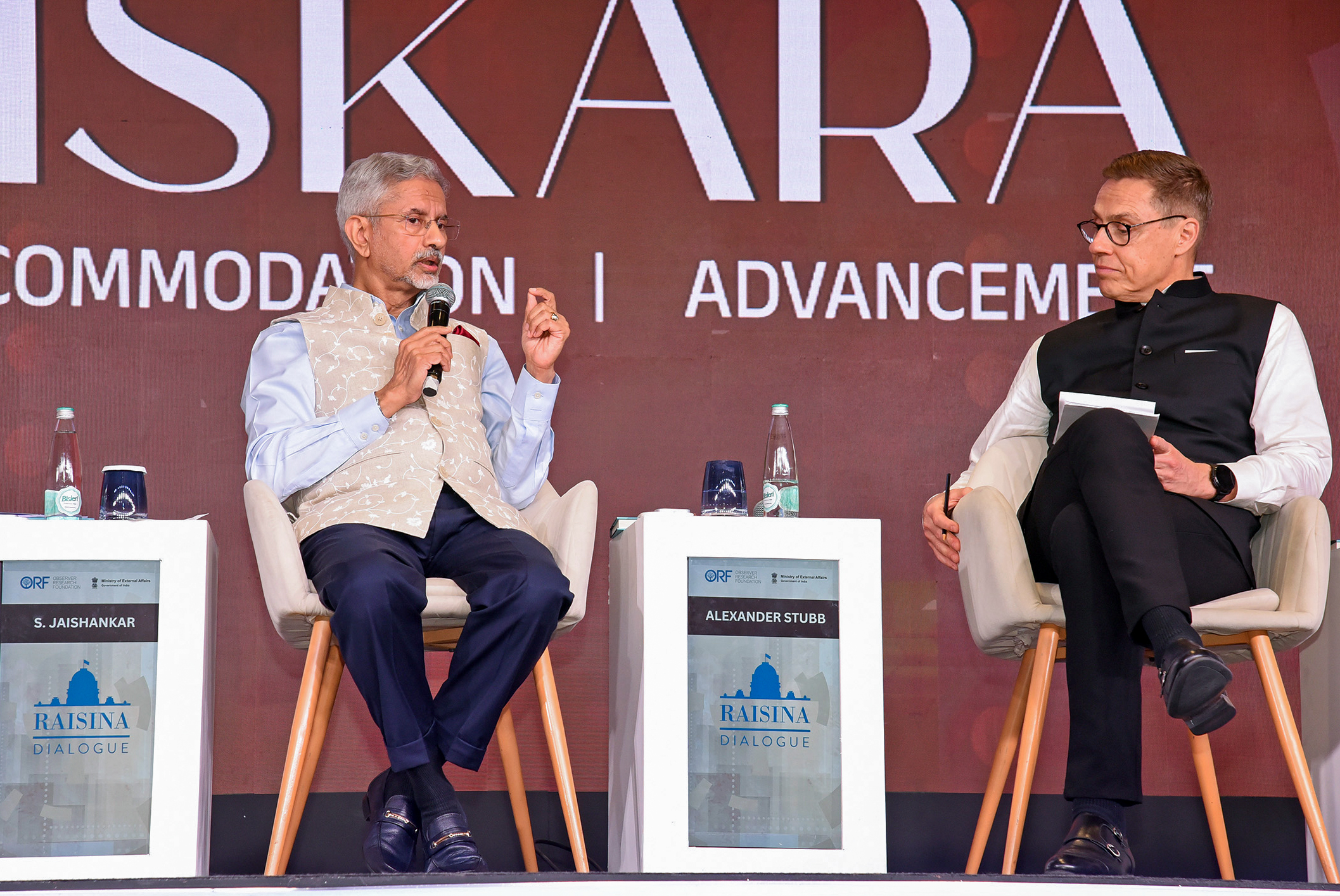
External Affairs Minister S. Jaishankar has said that the expectation of preserving the global order established in the mid-20th century indefinitely was unrealistic, noting that power in the world has now spread across multiple regions and domains.
Speaking at the Raisina Dialogue 2026 in New Delhi, Jaishankar reflected on the evolution of global governance over the past seven decades.
He observed that expecting the international system shaped by events such as 1945, marking the end of World War II, or 1989, the end of the Cold War, to remain unchanged indefinitely was not practical.
“When we look back at these 70 years, the expectation that we can freeze a 1945 or a 1989 forever was a very unrealistic one. If we debate why it did not last, we should remember that 70 years is barely one per cent of Indian history. Why would one per cent of history last forever? Life moves on,” Jaishankar said.
The External Affairs Minister noted that global discourse often remained overly attached to historical frameworks without adequately recognising the forces driving transformation in the world.
He pointed out that technology and demographics are likely to be the two major forces shaping global changes in the current decade.
“I think this attachment to the past did not take into account the forces that were propelling change. If there are going to be two big changes in this decade, one will be technology, but the other will be demographic,” he said.
Highlighting shifting global power dynamics, Jaishankar said much of the current geopolitical analysis continues to focus on developments in the United States, but the global system is gradually moving toward a multipolar order.
“My sense is that the future will be much more multipolar because no country today has hegemony over so many domains that it can be considered an overall hegemon,” he said.
He added that power in the modern world is no longer determined solely by traditional indicators such as economic size or military strength.
According to Jaishankar, different regions are likely to develop leadership in different domains, contributing to a broader distribution of global influence.
“It is not just about the distribution of GDP and capabilities. In different domains, different parts of the world will contribute more or have greater capabilities. Power in its different dimensions has therefore spread out much more,” he said.
-ANI