








Researchers in India have developed a novel lead-free and environmentally friendly photodetector that operates without external power and delivers stable, long-term performance, opening new possibilities for its use in consumer electronics, industrial monitoring, security systems and biomedical imaging.
The breakthrough has been achieved by researchers at the International Advanced Research Centre for Powder Metallurgy and New Materials (ARCI), Hyderabad – an autonomous institute under the Department of Science and Technology (DST) – in collaboration with the Indian Institute of Technology (IIT) Hyderabad. The findings have been published in the journal Solar Energy (Elsevier).
Photodetectors are essential components in modern cameras, environmental sensors, smart wearables and imaging systems, as they convert light into electrical signals. While many high-performance photodetectors currently rely on lead-based perovskites, these materials pose environmental and health concerns due to their toxicity and also tend to degrade under real-world operating conditions.
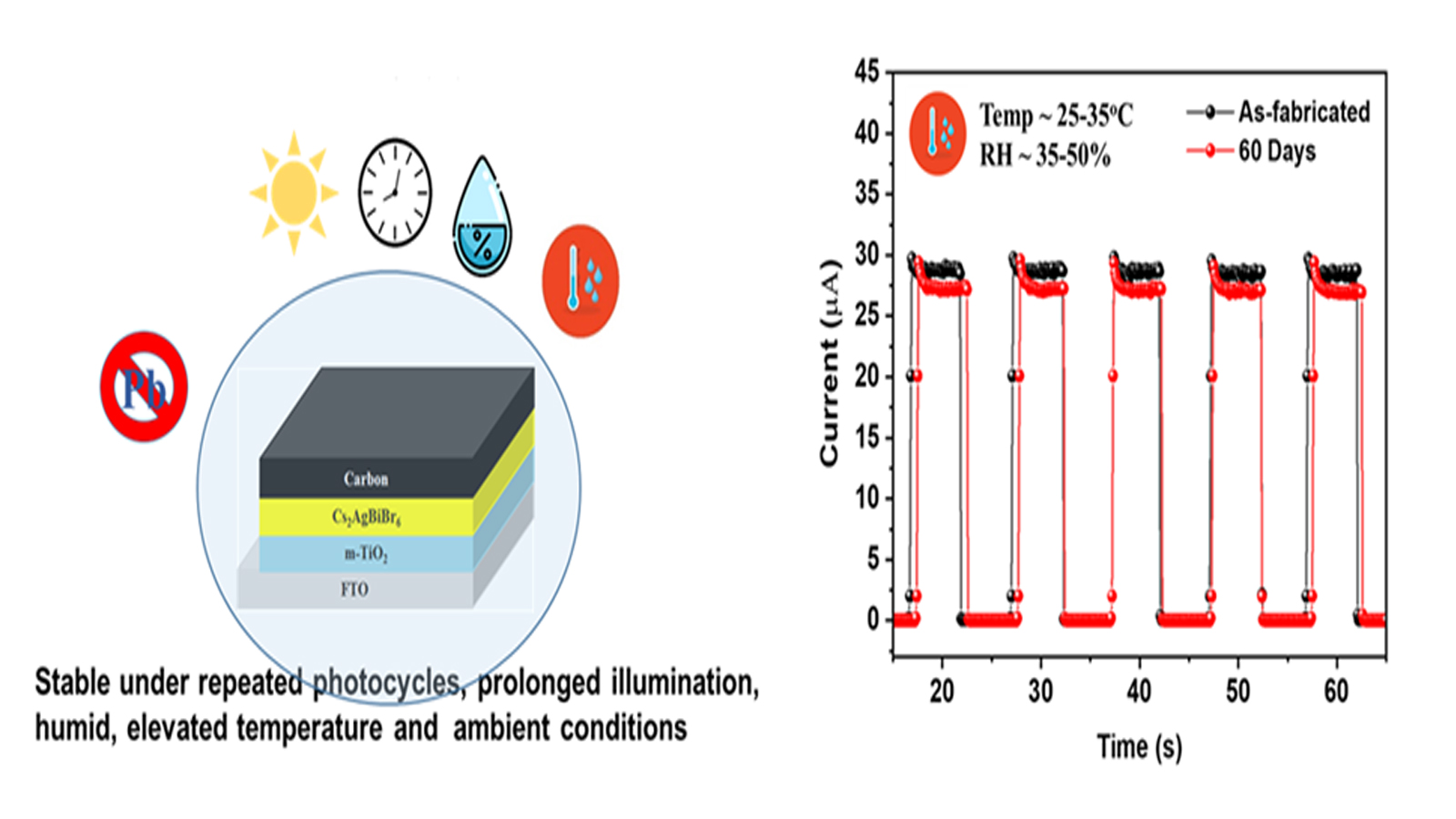
To address these challenges, the Indian researchers developed a photodetector based on the lead-free double perovskite material Cs2AgBiBr6. The device not only avoids toxic elements but also demonstrates strong responsiveness to visible light and excellent operational stability.
A key innovation of the new design lies in its simple and cost-effective fabrication. Unlike conventional photodetectors that require expensive metal contacts, additional hole-transport layers and controlled fabrication environments such as gloveboxes or vacuum systems, the new device is hole-transport-material (HTM)-free and uses low-cost carbon electrodes. It is fabricated entirely at room temperature through a single-step coating process under ambient conditions.
The device architecture naturally enables efficient charge separation, allowing the photodetector to operate in a self-powered mode without the need for any external voltage. Performance tests showed consistent ON-OFF switching behaviour and high reliability. Notably, the photodetector retained over 90 per cent of its performance even after 60 days of storage under normal room conditions, with temperatures between 25-35°C and relative humidity of 35-50 per cent.
Researchers highlighted that the close overlap of performance measurements taken immediately after fabrication and after two months of storage confirms the device’s long-term environmental stability – an important requirement for real-world applications.
With its combination of eco-friendly materials, low-cost components, simple ambient-processed fabrication and robust performance, the technology is seen as a promising candidate for widespread adoption in electronics and sensing applications. It also aligns with India’s broader goals of promoting sustainable materials, green manufacturing practices and self-reliance in advanced electronic technologies.
The study, titled “Ambient-processed lead-free Cs2AgBiBr6 photodetector with long-term environmental stability and self-powered operation,” was supported by the Department of Science and Technology, Government of India.